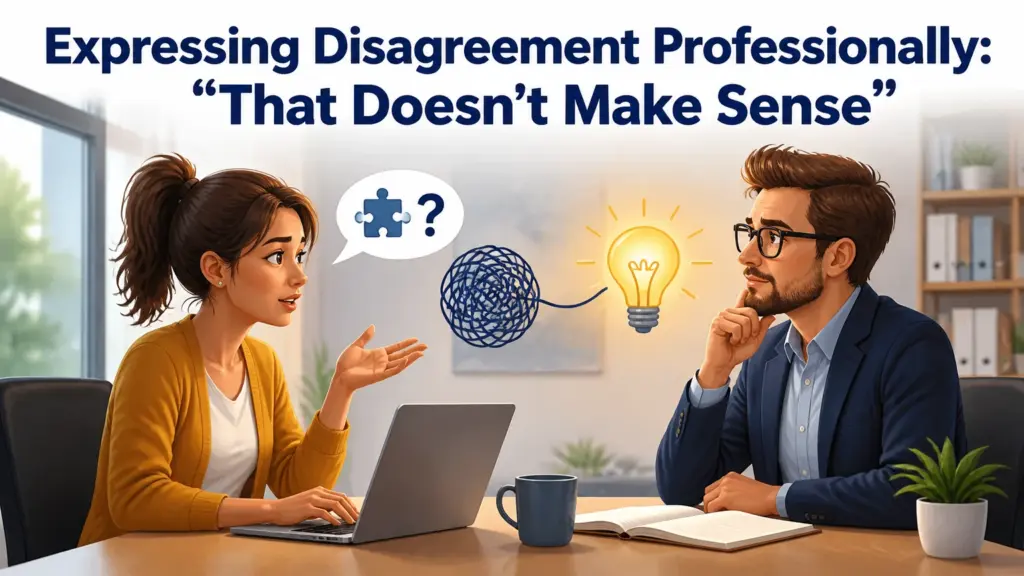

In professional settings, it’s crucial to communicate disagreement or lack of understanding effectively and respectfully. Simply stating “that doesn’t make sense” can come across as blunt or dismissive. Instead, using more nuanced and constructive phrases, such as “I’m having trouble understanding,” “could you clarify that point,” “I see it differently,” or “I might be missing something,” allows for clearer communication and collaboration. This article explores various professional ways to express that something is unclear or illogical, ensuring your message is received positively and promotes further discussion. Mastering these phrases enhances your ability to navigate complex conversations and contribute meaningfully in any professional environment.
Table of Contents
- Introduction
- Defining Professional Disagreement
- Structural Breakdown of Disagreement Phrases
- Types of Professional Disagreement
- Examples of Professional Disagreement
- Usage Rules for Professional Disagreement
- Common Mistakes to Avoid
- Practice Exercises
- Advanced Topics in Expressing Disagreement
- Frequently Asked Questions
- Conclusion
Defining Professional Disagreement
Professional disagreement involves expressing a differing opinion or a lack of comprehension in a manner that is respectful, constructive, and conducive to further discussion. It goes beyond simply saying “that’s wrong” or “I don’t understand.” Instead, it focuses on articulating your concerns or alternative perspectives in a way that encourages collaboration and problem-solving. This includes acknowledging the other person’s viewpoint, using tactful language, and focusing on the issue rather than the individual. The goal is to advance the conversation and reach a mutually agreeable solution, even when perspectives differ. Professional disagreement is a key skill for effective communication in any workplace.
Structural Breakdown of Disagreement Phrases
Professional disagreement phrases often follow a specific structure to soften the impact and encourage dialogue. A common structure involves:
- Acknowledgement: Start by acknowledging the other person’s contribution or perspective. This could be as simple as “I understand that…” or “I see your point.”
- Expressing Doubt or Confusion: Clearly state your difficulty in understanding or your differing viewpoint. This is where you would use phrases like “I’m having trouble understanding…” or “I see it differently because…”
- Providing Rationale (Optional): Briefly explain the reason for your confusion or disagreement. This adds context and helps the other person understand your perspective.
- Seeking Clarification or Suggesting Alternatives: End with a question or suggestion to move the conversation forward. For example, “Could you elaborate on that?” or “Perhaps we could consider…”
By following this structure, you can express disagreement in a way that is both clear and respectful.
Types of Professional Disagreement
Seeking Clarification
This type of disagreement arises when you don’t fully understand a point or concept. The goal is to gain a better understanding without implying that the other person is wrong. Phrases used in this category focus on requesting more information or a different explanation. For example, “Could you elaborate on that aspect a bit more?”.
Expressing Different Viewpoints
This type of disagreement acknowledges that there are multiple valid perspectives on a topic. The goal is to present your viewpoint without dismissing the other person’s perspective. Phrases used here often start with an acknowledgement of the other person’s idea, followed by the presentation of your own. For example, “I understand your point, but I see it differently because…”
Highlighting Logical Flaws
This type of disagreement involves pointing out inconsistencies or weaknesses in an argument or proposal. It’s important to be tactful and avoid being accusatory. Phrases used in this category often focus on asking questions that expose the logical flaw or suggesting alternative interpretations. For example, “I’m wondering if that approach might lead to…”
Suggesting Alternative Approaches
This type of disagreement focuses on offering alternative solutions or strategies. It acknowledges that the current approach might not be the most effective and proposes a different way forward. Phrases used here often start with a statement of agreement followed by a suggestion of an alternative. For example, “That’s a good idea, and we could also consider…”
Examples of Professional Disagreement
The following tables provide examples of phrases used to express disagreement professionally, categorized by the type of disagreement. Each table includes examples of different levels of formality.
Table 1: Seeking Clarification
This table contains phrases suitable for seeking clarification when something is unclear. These phrases prioritize understanding without implying fault.
| Formality Level | Phrase | Example Sentence |
|---|---|---|
| Informal | “I’m not quite following…” | “I’m not quite following – could you explain that again?” |
| Informal | “Can you walk me through that again?” | “Can you walk me through that again? I want to make sure I understand the process.” |
| Semi-Formal | “I’m having trouble understanding…” | “I’m having trouble understanding the connection between these two data points.” |
| Semi-Formal | “Could you clarify that point?” | “Could you clarify that point about the budget allocation?” |
| Semi-Formal | “I’d appreciate it if you could elaborate on…” | “I’d appreciate it if you could elaborate on the timeline for this project.” |
| Formal | “I’m not entirely clear on…” | “I’m not entirely clear on the rationale behind this decision.” |
| Formal | “Would you mind providing further details on…” | “Would you mind providing further details on the proposed methodology?” |
| Informal | “Sorry, I missed that. Could you repeat it?” | “Sorry, I missed that. Could you repeat it? I want to ensure I have all the details.” |
| Semi-Formal | “I’m a little confused about…” | “I’m a little confused about the new reporting procedure.” |
| Formal | “I require further clarification on…” | “I require further clarification on the legal implications of this agreement.” |
| Informal | “What do you mean by…?” | “What do you mean by ‘agile development’ in this context?” |
| Semi-Formal | “I’m unsure what you mean by…” | “I’m unsure what you mean by ‘synergy’ in this project.” |
| Formal | “I’m uncertain regarding the meaning of…” | “I’m uncertain regarding the meaning of ‘operational efficiency’ in this proposal.” |
| Informal | “Could you spell that out for me?” | “Could you spell that out for me? I’m not familiar with the acronym.” |
| Semi-Formal | “Could you provide a more detailed explanation of…?” | “Could you provide a more detailed explanation of the data analysis process?” |
| Formal | “A more comprehensive explanation of… would be appreciated.” | “A more comprehensive explanation of the risk assessment process would be appreciated.” |
| Informal | “So, just to be clear…” | “So, just to be clear, are you saying we need to cut the marketing budget?” |
| Semi-Formal | “To ensure I understand correctly…” | “To ensure I understand correctly, the deadline has been moved to next Friday?” |
| Formal | “For the sake of clarity…” | “For the sake of clarity, can you confirm the final decision?” |
| Formal | “Pardon me, but I didn’t quite catch that.” | “Pardon me, but I didn’t quite catch that. Could you please repeat the key figures?” |
Table 2: Expressing Different Viewpoints
This table shows phrases used to express a different opinion politely. The key is to acknowledge the other person’s viewpoint before presenting your own.
| Formality Level | Phrase | Example Sentence |
|---|---|---|
| Informal | “I see your point, but…” | “I see your point, but I think we should also consider the long-term impact.” |
| Semi-Formal | “I understand your perspective, however…” | “I understand your perspective, however, I believe a different approach might be more effective.” |
| Formal | “While I appreciate your input, I have a slightly different view…” | “While I appreciate your input, I have a slightly different view on this matter.” |
| Informal | “I’m not sure I completely agree…” | “I’m not sure I completely agree with cutting the research budget.” |
| Semi-Formal | “I’m not entirely convinced that…” | “I’m not entirely convinced that this is the best solution for our customers.” |
| Formal | “I have reservations about…” | “I have reservations about the proposed changes to the company policy.” |
| Informal | “I might be missing something, but…” | “I might be missing something, but I’m not sure how this aligns with our overall goals.” |
| Semi-Formal | “Perhaps I’m misunderstanding, but…” | “Perhaps I’m misunderstanding, but I thought the deadline was next week.” |
| Formal | “I may be mistaken, but…” | “I may be mistaken, but I believed we had already addressed this issue.” |
| Informal | “Have you considered…?” | “Have you considered the potential risks associated with this strategy?” |
| Semi-Formal | “It might be worth considering…” | “It might be worth considering the impact on employee morale.” |
| Formal | “It may be prudent to examine…” | “It may be prudent to examine the financial implications more closely.” |
| Informal | “Another way to look at it is…” | “Another way to look at it is from the customer’s perspective.” |
| Semi-Formal | “An alternative perspective might be…” | “An alternative perspective might be to focus on long-term growth rather than short-term profits.” |
| Formal | “A differing viewpoint may be…” | “A differing viewpoint may be to prioritize innovation over cost reduction.” |
| Informal | “I’m not sure that’s the best way to go about it…” | “I’m not sure that’s the best way to go about it, considering our limited resources.” |
| Semi-Formal | “I’m not convinced that this is the most efficient approach…” | “I’m not convinced that this is the most efficient approach, given the time constraints.” |
| Formal | “I harbor doubts as to whether this is the optimal solution…” | “I harbor doubts as to whether this is the optimal solution, considering the potential for unforeseen complications.” |
| Informal | “Just playing devil’s advocate here, but…” | “Just playing devil’s advocate here, but what if our competitors do the same thing?” |
| Semi-Formal | “To play devil’s advocate for a moment…” | “To play devil’s advocate for a moment, how will we measure the success of this initiative?” |
Table 3: Highlighting Logical Flaws
This table presents phrases used to gently point out potential logical flaws in an argument. The focus is on inquiry and suggestion rather than direct criticism.
| Formality Level | Phrase | Example Sentence |
|---|---|---|
| Informal | “I’m wondering if…” | “I’m wondering if that approach might lead to unintended consequences.” |
| Semi-Formal | “I’m a bit concerned that…” | “I’m a bit concerned that we haven’t fully considered the legal implications.” |
| Formal | “I have some concerns regarding…” | “I have some concerns regarding the feasibility of this plan given the current market conditions.” |
| Informal | “How does that fit in with…?” | “How does that fit in with our existing marketing strategy?” |
| Semi-Formal | “How does that align with…?” | “How does that align with our commitment to sustainability?” |
| Formal | “To what extent does this correlate with…?” | “To what extent does this correlate with our long-term financial goals?” |
| Informal | “I’m not sure if I see the connection…” | “I’m not sure if I see the connection between these two proposals.” |
| Semi-Formal | “I’m struggling to see the link between…” | “I’m struggling to see the link between the budget cuts and increased productivity.” |
| Formal | “I’m having difficulty discerning the correlation between…” | “I’m having difficulty discerning the correlation between the new software and improved efficiency.” |
| Informal | “Is there a risk that…?” | “Is there a risk that this change will alienate our existing customers?” |
| Semi-Formal | “Could this potentially lead to…?” | “Could this potentially lead to a decrease in employee satisfaction?” |
| Formal | “Is there a possibility that this might result in…?” | “Is there a possibility that this might result in a breach of contract?” |
| Informal | “What happens if…?” | “What happens if we don’t meet our sales targets?” |
| Semi-Formal | “What are the implications if…?” | “What are the implications if we miss the deadline?” |
| Formal | “What are the ramifications should…?” | “What are the ramifications should this project fail?” |
| Informal | “Wouldn’t that mean…?” | “Wouldn’t that mean we have to hire more staff?” |
| Semi-Formal | “Doesn’t that imply…?” | “Doesn’t that imply a significant increase in workload?” |
| Formal | “Does that not suggest…?” | “Does that not suggest a potential conflict of interest?” |
| Informal | “Are we sure that’s the best approach?” | “Are we sure that’s the best approach, given our current limitations?” |
| Semi-Formal | “Are we certain that this is the most effective method?” | “Are we certain that this is the most effective method, considering the cost?” |
Table 4: Suggesting Alternative Approaches
This table contains phrases for suggesting alternative approaches. It’s important to present these suggestions as options rather than criticisms.
| Formality Level | Phrase | Example Sentence |
|---|---|---|
| Informal | “What about…?” | “What about trying a different marketing strategy?” |
| Semi-Formal | “Have you thought about…?” | “Have you thought about implementing a new customer feedback system?” |
| Formal | “Might it be beneficial to consider…?” | “Might it be beneficial to consider a phased implementation?” |
| Informal | “Another option could be…” | “Another option could be to outsource the project.” |
| Semi-Formal | “An alternative approach might be…” | “An alternative approach might be to focus on a niche market.” |
| Formal | “A further possibility to explore is…” | “A further possibility to explore is partnering with another company.” |
| Informal | “Instead of that, maybe we could…” | “Instead of that, maybe we could try a pilot program first.” |
| Semi-Formal | “Rather than that, perhaps we could…” | “Rather than that, perhaps we could allocate the budget to a different area.” |
| Formal | “In lieu of that, it may be advantageous to…” | “In lieu of that, it may be advantageous to conduct a market analysis.” |
| Informal | “We could also try…” | “We could also try a different training method.” |
| Semi-Formal | “We might also consider…” | “We might also consider offering incentives to employees.” |
| Formal | “It may also be worthwhile to explore…” | “It may also be worthwhile to explore alternative funding sources.” |
| Informal | “How about we try…?” | “How about we try a different approach to problem-solving?” |
| Semi-Formal | “What if we were to…?” | “What if we were to implement a new project management system?” |
| Formal | “What would be the effect if we were to…?” | “What would be the effect if we were to restructure the department?” |
| Informal | “Have we thought about approaching it from a different angle?” | “Have we thought about approaching it from a different angle? Maybe we’re overcomplicating things.” |
| Semi-Formal | “Perhaps we could re-evaluate our strategy and consider…” | “Perhaps we could re-evaluate our strategy and consider a more customer-centric approach.” |
| Formal | “It might be prudent to reassess our current methodology and explore…” | “It might be prudent to reassess our current methodology and explore alternative revenue streams.” |
| Informal | “Maybe we’re missing a key element. What if we looked at…?” | “Maybe we’re missing a key element. What if we looked at the problem from a technical perspective?” |
| Semi-Formal | “It’s possible we’re overlooking something. Perhaps we should investigate…” | “It’s possible we’re overlooking something. Perhaps we should investigate the market trends more closely.” |
Usage Rules for Professional Disagreement
When expressing disagreement professionally, consider the following rules:
- Be Respectful: Always use polite and respectful language, regardless of your level of disagreement.
- Be Specific: Clearly articulate the reason for your disagreement. Avoid vague or general statements.
- Focus on the Issue: Address the idea or proposal, not the person presenting it.
- Listen Actively: Pay attention to the other person’s perspective and acknowledge their viewpoint.
- Offer Solutions: Whenever possible, provide alternative suggestions or solutions.
- Choose the Right Time and Place: Consider the context and audience when expressing disagreement. Some discussions are better held privately.
- Be Mindful of Tone: Your tone of voice and body language should convey respect and openness to discussion.
Common Mistakes to Avoid
Avoid these common mistakes when expressing disagreement professionally:
| Mistake | Example (Incorrect) | Example (Correct) |
|---|---|---|
| Being overly direct or blunt | “That’s a stupid idea.” | “I’m not sure that’s the best approach. Have we considered…?” |
| Using accusatory language | “You’re wrong about that.” | “I see it differently because…” |
| Dismissing the other person’s viewpoint | “That doesn’t make any sense.” | “I’m having trouble understanding that point. Could you clarify?” |
| Focusing on personal attacks | “You’re just saying that because…” | “I’m not sure that’s relevant to the issue at hand.” |
| Interrupting the other person | (Interrupting) “But that’s not true!” | (Waiting for a pause) “I have a slightly different perspective on that.” |
Practice Exercises
Test your understanding with these practice exercises. For each scenario, choose the most appropriate phrase to express disagreement professionally.
Exercise 1
| Question | Options | Answer |
|---|---|---|
| Your colleague proposes a marketing strategy that you believe is too risky. | a) “That’s a terrible idea.” b) “I’m not sure that’s the best approach. Have we considered a more conservative strategy?” c) “You’re completely wrong about that.” | b |
| Your boss presents a budget plan that you think is unrealistic. | a) “That’s impossible.” b) “I have some concerns regarding the feasibility of this plan.” c) “You’re out of your mind.” | b |
| A team member suggests a solution that you believe is too complex. | a) “That’s too complicated.” b) “I’m wondering if that approach might lead to unintended consequences.” c) “That’s ridiculous.” | b |
| Someone suggests a change that goes against company policy. | a) “That’s against the rules!” b) “I’m not sure if that aligns with our company policy.” c) “You can’t do that!” | b |
| Your coworker suggests a new software that is incompatible with the company system. | a) “That won’t work.” b) “I don’t think that’s compatible with our system.” c) “That’s a waste of money.” | b |
| Your manager suggests lowering prices, but you think it will decrease profits. | a) “That’s a bad idea.” b) “I’m concerned that lowering prices will decrease profits.” c) “You’re going to bankrupt us.” | b |
| A colleague suggests a plan that is not cost effective. | a) “That’s expensive.” b) “I’m not sure if that is cost effective.” c) “You’re wasting money.” | b |
| Someone thinks you should switch to a new vendor. | a) “That’s stupid.” b) “I am not sure if we should switch vendors.” c) “You’re an idiot.” | b |
| A coworker suggests that you should work overtime every day. | a) “That’s insane.” b) “I don’t think working overtime every day is sustainable.” c) “You’re crazy.” | b |
| Your boss thinks you should fire one of your colleagues. | a) “That’s a horrible thing to do.” b) “I don’t think we should fire them.” c) “You’re a monster.” | b |
Exercise 2
Rewrite the following sentences to express disagreement more professionally.
- Original: “That’s completely wrong!”
Revised: “I see it differently because…” - Original: “That makes no sense at all.”
Revised: “I’m having trouble understanding that point. Could you clarify?” - Original: “That’s a ridiculous idea.”
Revised: “I’m wondering if that approach might lead to unintended consequences.” - Original: “You’re just wrong.”
Revised: “I’m not entirely convinced that…” - Original: “That’s impossible.”
Revised: “I have some concerns regarding the feasibility of this plan.” - Original: “This is a stupid proposal”
Revised: “I am not sure this proposal aligns with our mission statement.” - Original: “You are an idiot if you think that will work.”
Revised: “I don’t think that strategy will be effective.” - Original: “That’s complete garbage”
Revised: “I have a different perspective on this matter.” - Original: “You are going to bankrupt us”
Revised: “I am concerned about the cost of this plan.” - Original: “This is a waste of time”
Revised: “I am not sure if this is the best use of our time.”
Advanced Topics in Expressing Disagreement
For advanced learners, consider these nuances when expressing disagreement:
- Cultural Sensitivity: Be aware that communication styles vary across cultures. What is considered direct in one culture may be considered rude in another.
- Nonverbal Communication: Pay attention to your body language and facial expressions. Maintain a neutral and respectful demeanor.
- Strategic Disagreement: Sometimes, it’s more effective to delay expressing disagreement until you have more information or support from others.
- Expressing Disagreement to Superiors: When disagreeing with a superior, be especially tactful and respectful. Frame your disagreement as a question or suggestion, and always acknowledge their authority.
Frequently Asked Questions
- Q: Is it ever okay to be direct when expressing disagreement?
A: Yes, in certain situations, such as when there is a clear and immediate safety risk, directness may be necessary. However, even in these situations, try to remain respectful and avoid accusatory language. - Q: How do I handle it when someone becomes defensive after I express disagreement?
A: Acknowledge their feelings and reiterate your respect for their viewpoint. Focus on the issue at hand and avoid getting drawn into personal attacks. You can say something like, “I understand that you feel strongly about this, and I respect your opinion. However, I still have some concerns about…” - Q: What if I’m not sure why I disagree with something?
A: It’s okay to admit that you’re not sure why you disagree. You can say something like, “I’m having trouble articulating my concerns, but something about this doesn’t feel right to me. Could we explore this further?” - Q: How can I practice expressing disagreement professionally?
A: Role-playing with a colleague or friend can be a helpful way to practice. You can also observe how others express disagreement effectively in meetings or conversations. - Q: What if my disagreement is based on a personal value or belief?
A: It’s important to be respectful of others’ values and beliefs, even if they differ from your own. Focus on the practical implications of the issue at hand and avoid imposing your personal values on others. - Q: What is the difference between disagreeing and being argumentative?
A: Disagreeing is about expressing a different opinion or perspective respectfully, while being argumentative is about trying to win an argument at all costs. Argumentative behavior often involves personal attacks, interrupting, and refusing to listen to other viewpoints. - Q: How do I disagree with someone who is more experienced or knowledgeable than me?
A: Acknowledge their experience and expertise, then gently express your concerns or alternative perspective. For example, “I understand you have a lot of experience in this area, and I respect your judgment. However, I’m wondering if we should also consider…” - Q: What if I am the only one who disagrees with a decision?
A: It can be difficult to be the only dissenting voice, but it’s important to express your concerns if you genuinely believe something is wrong. Be respectful and articulate your reasons clearly, even if you know your opinion may not be popular.
Conclusion
Expressing disagreement professionally is a vital skill for effective communication and collaboration in any workplace. By using tactful language, acknowledging different viewpoints, and focusing on the issue rather than the individual, you can foster constructive dialogue and contribute to better decision-making. Remember to choose your words carefully, listen actively, and offer alternative solutions whenever possible. Practicing these techniques will help you navigate challenging conversations with confidence and maintain positive working relationships. By mastering the art of professional disagreement, you can enhance your influence and contribute meaningfully to your team’s success.