
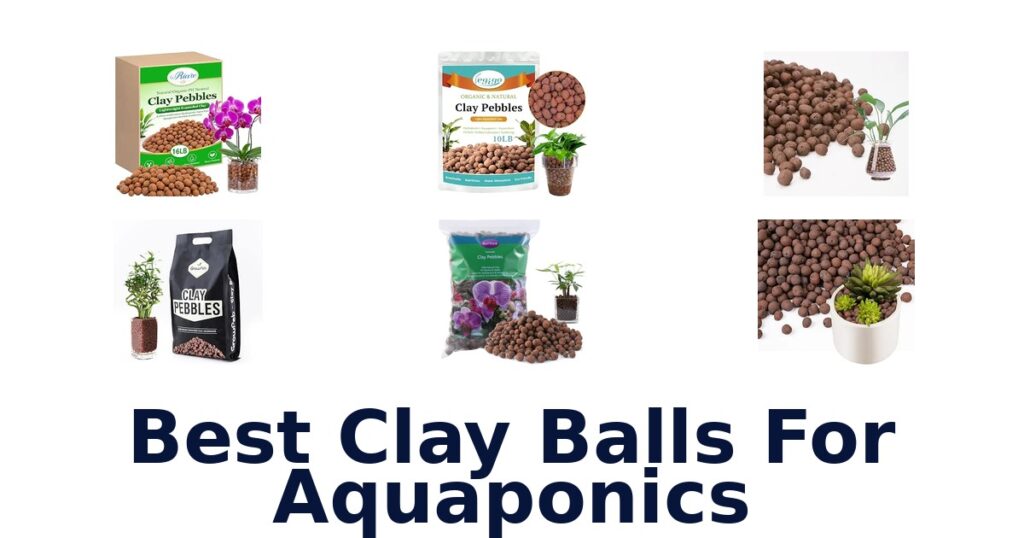

A strong choice for aquaponics is a porous clay medium with a suitable size and enough material for your grow bed; Rahato and Pulovin explicitly list aquaponics among their uses. This roundup compares 10 expanded-clay products, from small 250 g packs to a listed 36 lb option, with sizes ranging from 4–16 mm to 8–15 mm. Those details matter because particle size affects fit with your setup, while pack size determines how much media you can fill with.
Some products name aquaponics directly, while others are described more broadly for hydroponics, drainage, or horticulture. The rankings favor clear aquaponics suitability first, then useful size and pack details.
Product descriptions do not establish water-system performance, so consider rinsing and checking media before putting it into a stocked system.
Rahato Clay Pebbles is the best overall choice in this list for aquaponics because its product description specifically names aquaponics and aquaculture gardening, alongside a 4–16 mm size range. Pulovin Clay Pebbles is another directly relevant 4–16 mm option. For growers who prefer an 8–15 mm specification, GrowPeb LECA is explicitly designed for aquaponics and lists a 5 L pack.
Match the selected size and quantity to your grow bed, and prepare the media before use; the listings do not provide water-system test results.
Our Top Picks
 Best Overall
Its description explicitly lists aquaponics and aquaculture gardening, and the 4–16 mm size range suits a variety of small and medium growing setups.
View on Amazon Aquaponics Pick
Aquaponics and aquaculture gardening are named uses, with 4–16 mm pebbles and a 10 lb pack listed for grow-bed use.
View on Amazon Best 8–15 mm
The description specifically includes aquaponics and lists 8–15 mm pebbles in a 5 L pack, offering a distinct narrower size specification.
View on Amazon- Small Pack Rurtsva Clay Pebbles
- Largest Listed Pack Voulosimi Clay Pebbles
Compare the Clay Pebble Options
| # | Product | Weight | Buy |
|---|---|---|---|
| 1 | 1. Rahato Clay PebblesBest Overall | — | View on Amazon |
| 2 | 2. Pulovin Clay PebblesAquaponics Pick | — | View on Amazon |
| 3 | 3. GrowPeb LECABest 8–15 mm | 2.49 lb | View on Amazon |
| 4 |  4. Rurtsva Clay PebblesSmall Pack | 0.88 kg | View on Amazon |
| 5 |  5. Halatool Clay PebblesCompact Dutch-Bucket Setup | — | View on Amazon |
| 6 |  6. Legigo LECA PebblesCompact Aquaponics Pot Filler | 10 lb | View on Amazon |
| 7 |  7. Riare LECA PebblesLarger Multi-Container Supply | 16 lb | View on Amazon |
| 8 |  8. Sunwinx LECA PebblesWater-Stable Soilless Grower | — | View on Amazon |
| 9 |  9. Voulosimi Clay PebblesLargest Listed Pack | 34.2 lb | View on Amazon |
| 10 |  10. RAINFLOW Clay PebblesSmall-Pot Fine-Size Topper | 0.29 kg | View on Amazon |
Detailed Reviews: Best Clay Balls For Aquaponics
#1 · Best Overall
1. Rahato Clay Pebbles
Best for: Aquaponics-Labeled Clay Media.
Why it ranks #1: Its description explicitly lists aquaponics and aquaculture gardening, and the 4–16 mm size range suits a variety of small and medium growing setups.
Rahato explicitly names aquaponics and aquaculture gardening among its uses, making those applications the clearest reason to consider these 4–16 mm clay pebbles. The natural clay is described as chemical-free and pH-neutral, while the mixed size range is intended for small and medium pots as well as varied planting needs.
The direct aquaponics and aquaculture use listing gives system growers a clear application match, while the 4–16 mm range also supports use in small and medium pots. Rahato identifies the clay as natural, chemical-free, and pH-neutral, attributes relevant to buyers selecting a medium for soilless growing. Its porous structure is also highlighted in the supplied features, though no specific pore measurement or water-flow rate is provided for sizing a system.
- Aquaponics and aquaculture gardening are explicitly listed
- Natural clay described as chemical-free
- pH-neutral medium
- 4–16 mm size range for small and medium pots
- The listed features do not state a pack weight.
Skip it if you need a stated bulk quantity; Voulosimi lists a 36-pound supply for larger-scale media filling.
Rahato is a straightforward fit for aquaponics or aquaculture gardeners who value an explicitly listed application and mixed 4–16 mm clay. Check the stated product details carefully if a specific total quantity is central to planning.
Full product details
| Brand | Rahato |
|---|---|
| Manufacturer | Rahato |
| Part Number | 553800 |
| Style | Clay-based |
| Style Name | Clay-based |
| Additional Information | Important information Safety Information None identified, check packaging for details |
Listed on Amazon as: 10 lbs LECA Clay Pebbles for Plants, 4-16mm Lightweight Clay Balls
View on Amazon#2 · Aquaponics Pick
2. Pulovin Clay Pebbles
Best for: Multi-Use Aquaponics Grower.
Why it ranks #2: Aquaponics and aquaculture gardening are named uses, with 4–16 mm pebbles and a 10 lb pack listed for grow-bed use.
Pulovin specifically lists aquaponics and aquaculture gardening, giving water-based growers a direct application match in a 10-pound bag of 4–16 mm pebbles. The supplied features describe the lightweight, well-ventilated clay as supporting root development, while its size range also fits small and medium pots and varied planting uses.
The explicit aquaponics and aquaculture listings help narrow the choice for growers building a water-based planting setup, while the 4–16 mm range supports use in small and medium pots. Pulovin links the medium’s light weight and ventilation with root development, and also identifies drainage capacity as a feature. That combination makes it relevant for buyers considering both system media and container use, without a stated uniform-size grade or pack-weight specification in the supplied details.
- Aquaponics and aquaculture gardening explicitly listed
- 4–16 mm size range
- Lightweight and well-ventilated properties are stated
- Drainage capacity is highlighted
- The supplied specifications do not state a pack weight.
Skip it if you need a clearly stated large supply; Voulosimi identifies a 36-pound quantity for larger projects.
Pulovin is a sensible option for aquaponics growers who want a product explicitly listed for water-based cultivation and also use media in small or medium pots. Confirm that its mixed size range suits the planned growing area.
Full product details
| Brand | Pulovin |
|---|---|
| Manufacturer | Pulovin |
| Part Number | clayPebbles-10 |
| Style Name | Clay-based |
Listed on Amazon as: 10 lbs LECA Clay Pebbles for Plants, 4-16mm LECA Balls for Indoor Plants Drainage, Hydroponics, Aquaponics, Natural Clay Balls for Soil Root Development, Orchid Potting Mix
View on Amazon#3 · Best 8–15 mm
3. GrowPeb LECA
- Weight: 2.49 lb
Best for: Specified-Grade System Grower.
Why it ranks #3: The description specifically includes aquaponics and lists 8–15 mm pebbles in a 5 L pack, offering a distinct narrower size specification.
GrowPeb specifies an 8–15 mm horticultural-grade size and names deep water culture, ebb and flow, drip systems, aquaponics, and semi-hydroponics. That clearly defined grade helps system growers plan their media choice, while the porous structure is described as supplying root-zone oxygen and wicking moisture upward through capillary action.
The 8–15 mm specification provides a defined grade for growers choosing media for a particular system, and the listed compatibility spans deep water culture, ebb and flow, drip, aquaponics, and semi-hydroponics. GrowPeb connects porosity with root-zone oxygen and capillary moisture movement, useful context for buyers considering water and air availability around roots. The 5-liter volume offers a unit-based quantity, while the listed 2.49-pound weight provides a separate reference for handling and storage.
- Specified 8–15 mm size
- Aquaponics and several hydroponic systems listed
- Porous structure described as providing root-zone oxygen
- Capillary action described as wicking moisture upward
- The listed pack is 5 liters, which may be limited for filling a large system.
Skip it if you need a much larger stated quantity; Voulosimi lists 36 pounds for growers filling a bigger area.
GrowPeb suits system growers who want a specified 8–15 mm grade and explicit aquaponics compatibility, with porosity and capillary action described for root-zone conditions. Its 5-liter pack may not cover a large growing area.
Full product details
| Brand | GrowPeb |
|---|---|
| Item Weight | 2.49 pounds |
| Item model number | GrowPeb |
| Manufacturer | GrowPeb |
| Dimensions | 12.2 x 8.27 x 3.15 inches |
Listed on Amazon as: Premium Expanded Clay Pebbles 5L – Horticultural-Grade 8-15mm LECA Balls for Hydroponics, Aquaponics, Orchids & Indoor Plants – pH Neutral, Low EC, Reusable Growing Medium
View on Amazon#4 · Small Pack
4. Rurtsva Clay Pebbles
- Weight: 0.88 kg
Best for: Small-Batch Aquaponics Trial.
Why it ranks #4: Aquaponics is explicitly listed as a use, and its 8–15 mm pebbles come in a 2 lb pack for smaller media requirements.
A 2-pound quantity makes Rurtsva a small-batch option for growers who want expanded clay media without starting with a large supply. The listed 8–15 mm size targets a narrower range than many mixed-size alternatives, and the title specifically includes aquaponics alongside hydroponics, drainage, orchids, and succulents.
The 8–15 mm specification gives buyers a defined size range to plan around, while the 2-pound quantity can suit a limited planting area or a first fill rather than a bulk setup. Rurtsva lists aquaponics and hydroponics among its uses, along with orchids and succulents, so the media spans water-based and container applications. The supplied information also identifies it as expanded LECA, but does not provide a stated reuse procedure.
- 2-pound quantity for a small project
- Specified 8–15 mm size range
- Aquaponics and hydroponics listed as uses
- Expanded LECA also listed for orchids and succulents
- The 2-pound quantity is limited for filling a larger system.
Skip it if you need enough media for a large setup; Voulosimi lists a 36-pound supply for broader filling needs.
Rurtsva fits aquaponics growers testing a small planting area or topping up a limited amount of media, especially when 8–15 mm is suitable. Its 2-pound quantity is a boundary for larger grow beds or extensive systems.
Full product details
| Brand | Rurtsva |
|---|---|
| Item Weight | 0.88 kg |
| Manufacturer | LingshouxianJiechengkuangchanpinjiagongchang Lingshouxian chunyan Kuangchanpin Jiagongchang |
| Part Number | MY-CP-000 |
| Model Number | MY-CP-000 |
| Style | Potting,Garden |
| Style Name | Potting,Garden |
| Additional Information | Important information Safety Information Handle with care to avoid inhalation of dust. Wash hands after use. Follow local regulations for disposal of organic materials. |
Listed on Amazon as: Natural Clay Pebbles 2LBS– 8mm-15mm Expanded Leca Balls for Hydroponics Plants Drainage Grow Media Reusable Soil Amendment for Orchids, Succulents, Aquaponics
View on Amazon#5
5. Halatool Clay Pebbles
Best for: Compact Dutch-Bucket Setup.
Why it ranks #5: The 4–16 mm size range offers flexibility, and product information mentions Dutch bucket setups, though aquaponics is not specifically named in the listed features.
Halatool’s 4–16 mm size range is described for uses ranging from orchids to Dutch bucket setups, giving growers flexibility across container and hydroponic-style planting. The 6-pound quantity is a smaller supply than bulk offerings, which can suit a limited project or a targeted refill without taking on a large volume of media.
A 6-pound pack keeps the quantity manageable for a small planting area, while the 4–16 mm range gives growers options for different listed uses, including orchids and Dutch bucket setups. Halatool also describes the pebbles as expanded clay and natural, organic, and easy to use. Its safety information specifies indoor use only, a relevant boundary for buyers planning where to handle or place this media.
- 6-pound quantity for limited projects
- 4–16 mm size range
- Listed for orchids and Dutch bucket setups
- Safety information specifies indoor use
- The supplied safety information limits use to indoors.
Skip it if you plan an outdoor growing system; Rahato lists aquaponics and aquaculture gardening without Halatool’s stated indoor-use boundary.
Halatool suits indoor growers needing a modest quantity for a Dutch bucket setup, orchid container, or similar project. Its stated indoor-use limitation makes it a poor fit for buyers planning to use the pebbles outdoors.
Full product details
| Brand | Halatool |
|---|---|
| Manufacturer | Halatool |
| Part Number | Clay pebbles-6LB |
| Model Number | Clay pebbles-6LB |
| Style | Modern |
| Style Name | Modern |
| Additional Information | Important information Safety Information Always handle with care. Avoid inhalation and contact with skin and eyes. Keep out of reach of children and pets. Do not ingest. For indoor use only. Dispose of responsibly. |
Listed on Amazon as: 6LB Clay Pebbles, 4-16mm Hydro Balls for Drainage & Aeration
View on Amazon#6
6. Legigo LECA Pebbles
- Weight: 10 lb
Best for: Compact Aquaponics Pot Filler.
Why it ranks #6: This 10 lb product lists 4–16 mm pebbles for hydroponics and indoor plants, but does not specifically identify aquaponics as a use.
A 4–16 mm size range makes Legigo’s 10-pound bag a practical pick for small and medium pots, while also giving aquaponics growers mixed-size clay media to work with. The natural clay is baked at high temperature, and the resealable foil pouch helps keep unused pebbles clean and dry between planting sessions.
The mixed 4–16 mm pebbles suit small and medium containers, so one bag can serve varied potting and hydroponic uses without requiring a single uniform size. Legigo describes the natural clay as pH neutral, a useful property when selecting media for water-based growing. Its 10-pound quantity offers a manageable supply for smaller setups, and the resealable foil pouch supports tidier storage after filling pots or garden containers.
- Mixed 4–16 mm pebble size
- 10-pound quantity for small and medium pots
- Natural clay baked at high temperature
- Resealable pouch keeps unused pebbles clean and dry
- The listed size range is broad rather than a uniform grade.
Skip it if you need a specified aquaponics-focused product; Rahato explicitly lists aquaponics among its applications.
Choose Legigo for small or medium pots and modest hydroponic or aquaponic use where mixed-size media and resealable storage are useful. Its 10-pound supply and broad particle range may not suit growers seeking one uniform grade.
Full product details
| Brand | Legigo |
|---|---|
| Item Weight | 10 pounds |
| Manufacturer | Legigo |
| Part Number | L-UK-CLay Ball-10lb |
| Model Number | L-CA-Clay Ball |
| Style | Hydroponics, Indoor Plants Care, Drainage |
| Style Name | Hydroponics, Indoor Plants Care, Drainage |
| Additional Information | Important information Safety Information Avoid inhaling dust and contact with eyes. Handle with care and wash hands after use. |
Listed on Amazon as: 10LB Leca Clay Pebbles for Plants 4mm-16mm Clay Balls for Hydroponic
View on Amazon#7
7. Riare LECA Pebbles
- Weight: 16 lb
Best for: Larger Multi-Container Supply.
Why it ranks #7: Its 16 lb pack and 4–16 mm mixed sizes provide useful quantity and size information, but the description does not specifically mention aquaponics.
Riare’s 16-pound supply is the key advantage for growers filling several containers or replenishing media across a small system. Its approximately 4–16 mm mixed sizes are listed for hydroponic net pots, orchid containers, propagation jars, and small to medium pots, while a resealable bag helps organize what remains between uses.
The combination of a 16-pound quantity and several stated container uses can simplify stocking for growers who work across pots, net pots, and propagation jars. Mixed 4–16 mm particles offer flexibility among those formats rather than a single narrow grade. Riare describes the fired natural clay as inert and odorless, relevant qualities for a growing medium, and the resealable bag helps keep unused pebbles clean, dry, and organized during storage.
- 16-pound quantity
- Mixed sizes approximately 4–16 mm
- Listed for net pots, orchid containers, and propagation jars
- Resealable bag keeps unused pebbles clean and dry
- The listed mixed sizes may not suit a setup requiring one uniform particle grade.
Skip it if you need a smaller stated aquaponics-specific pack; Rahato lists aquaponics directly and comes in a 10-pound quantity.
Riare suits growers who need a larger mixed-size supply for multiple pots, net pots, or propagation jars. Consider the broad particle range when choosing media for a setup that calls for a tightly controlled, uniform size.
Full product details
| Brand | Riare |
|---|---|
| Item Weight | 16 pounds |
| Manufacturer | Riare |
| Part Number | Organic Expanded Clay Pebbles for Plants |
| Model Number | Organic Expanded Clay Pebbles for Plants |
| Style | Potting Mix,Garden |
| Style Name | Potting Mix,Garden |
Listed on Amazon as: 16LB Organic Leca Clay Pebbles for Plants, 4-16mm Drainage Leca Balls
View on Amazon#8
8. Sunwinx LECA Pebbles
Best for: Water-Stable Soilless Grower.
Why it ranks #8: The 16 lb pack and 4–16 mm range suit hydroponic growing, but the supplied product details do not explicitly list aquaponics.
Sunwinx describes its natural clay pebbles as inert, odorless, and stable in water, a combination that suits growers choosing media for hydroponic or semi-hydro setups. The 16-pound bag contains mixed 4–16 mm sizes, giving buyers a substantial supply for small and medium pots, net pots, and other listed planting uses.
The stated water stability and pH-neutral character support selection for water-based growing, while the 4–16 mm mix gives options for small and medium pots and net pots. Sunwinx also describes internal pores in a honeycomb structure that can help discharge excess water and avoid water accumulation, connecting the pebble structure to drainage needs. A 16-pound quantity supports multiple containers, though the range is mixed rather than a single specified size.
- 16-pound supply
- Natural, pH-neutral clay described as inert and stable in water
- Mixed 4–16 mm sizes
- Honeycomb pores described as helping discharge excess water
- The 4–16 mm range is mixed rather than a single specified size.
Skip it if you need an explicitly stated aquaponics application; Pulovin lists aquaponics directly among its uses.
Sunwinx suits hydroponic and semi-hydro growers seeking water-stable, pH-neutral clay in a 16-pound mixed-size supply. Its stated 4–16 mm spread is worth considering when a particular system requires a narrower particle grade.
Full product details
| Brand | Sunwinx |
|---|---|
| Manufacturer | Sunwinx |
| Part Number | S-Clay Pebble-16lb |
| Model Number | S-Clay Pebble |
| Style | Organic, Natural, Hydroponics, Indoor Plants, Drainage |
| Style Name | Organic, Natural, Hydroponics, Indoor Plants, Drainage |
Listed on Amazon as: 16LB Organic Leca Clay Pebbles for Plants, 4-16mm Natural Leca Ball
View on Amazon#9 · Largest Listed Pack
9. Voulosimi Clay Pebbles
- Weight: 34.2 lb
Best for: Bulk Aquaponics Media Supply.
Why it ranks #9: The listing gives a 36 lb pack and 0.3–0.5 inch size, but describes horticulture and hydroponics rather than aquaponics specifically.
Voulosimi lists a 36-pound quantity and a 0.3–0.5 inch size specification, making this the bulk option for growers planning to fill a larger area. Its features name hydroponic and aeroponic applications, proper drainage, balanced capillary action, and pH-neutral clay, supporting consideration for water-based growing systems.
The 36-pound quantity can serve a larger media requirement than small packs, while the stated 0.3–0.5 inch range gives buyers a measurement to compare with their setup. Voulosimi describes the clay as non-toxic, sterile, and pH neutral, and identifies drainage and balanced capillary action as functional properties. Hydroponics and aeroponics are explicitly named, making the product relevant to water-based growing, though aquaponics is not specifically listed in the supplied features.
- 36-pound quantity for larger projects
- Specified 0.3–0.5 inch size
- pH-neutral clay described as non-toxic and sterile
- Hydroponic and aeroponic applications listed
- Aquaponics is not specifically named among the listed applications.
Skip it if you require explicit aquaponics labeling; GrowPeb lists aquaponics and several named hydroponic systems.
Voulosimi suits growers who need a bulk supply for horticultural, hydroponic, or aeroponic use and can work with the stated 0.3–0.5 inch size. Buyers seeking explicit aquaponics labeling should weigh that boundary.
Full product details
| Brand | Voulosimi |
|---|---|
| Item Weight | 34.2 pounds |
| Item model number | edfr-01q |
| Manufacturer | Voulosimi |
| Dimensions | 7 x 3 x 4 inches |
Listed on Amazon as: Voulosimi Clay Pebbles Hydroponic Rocks Organic Ceramsite Grow Media for Horticultural,Orchids,Drainage (36LB)
View on Amazon#10
10. RAINFLOW Clay Pebbles
- Weight: 0.29 kg
Best for: Small-Pot Fine-Size Topper.
Why it ranks #10: The 5–10 mm size is specified, but the additional description identifies only a 250 g pack and the listing does not name aquaponics.
RAINFLOW’s 5–10 mm pebbles are a narrower, smaller-size option for small and medium pots, with the listing also naming hydroponics, soil mixes, and pot bottoms. The product description links aeration, moisture retention, and drainage with oxygen delivery to roots, giving growers several stated uses for the same clay media.
The 5–10 mm range differentiates this product from broader 4–16 mm mixes and is specifically described as suitable for small and medium pots. RAINFLOW lists use in hydroponics, soil mixes, and as pot-bottom drainage, so buyers can direct the pebbles to different planting tasks. Its stated 250 g pack is a small quantity, helpful for limited applications but a constraint when filling larger containers or a full aquaponics system.
- Narrower 5–10 mm size range
- Listed for small and medium pots
- Suitable for hydroponics, soil mixes, and pot bottoms
- Aeration, moisture retention, and drainage are stated
- The stated 250 g pack is small for filling a larger system.
Skip it if you need a larger supply for a full setup; Riare lists a 16-pound pack for broader multi-container use.
RAINFLOW fits growers seeking small-size clay pebbles for a limited pot, hydroponic use, or pot-bottom drainage. The 250 g quantity is a clear boundary for anyone planning to fill a larger aquaponics area.
Full product details
| Brand | RAINFLOW |
|---|---|
| Color | brown |
| Item Form | Solid |
| Item Weight | 0.29 kg |
| Manufacturer | RAINFLOW |
| Material | clay |
| Model Number | LHM15-Clay-Pebbles |
Listed on Amazon as: RAINFLOW Leca Clay Pebbles for Plants – 5-10mm Clay Balls for Gardening
View on AmazonPrepare the media before adding it to a fish system
Rinse clay pebbles before use to remove loose dust, and avoid pouring unprepared media directly into an operating aquaponics system. The listings repeatedly caution about dust: Legigo advises avoiding inhalation and eye contact, Rurtsva says to handle carefully to avoid inhaling dust, and Halatool also warns against inhalation. These warnings make preparation a practical concern, not a product-performance claim.
None of the supplied listings specifies a required soak time, a validated rinsing method, or test results for water clarity. Start by separating debris and rinsing the media outside the system, then check the water before introducing it to fish.
Do not assume a pH-neutral claim guarantees unchanged system water: some products describe themselves as pH neutral, but the product data does not provide independent measurements or explain the effect of repeated use.
Check size against bed openings and root space
Choose pebbles that stay in your grow bed while leaving adequate space for water flow and roots. Most listed products specify a broad 4–16 mm range, including Rahato and Pulovin, while GrowPeb and Rurtsva list 8–15 mm and RAINFLOW lists 5–10 mm. A mixed range gives you a spread of particle sizes, but the listings do not state how much of each size is included.
That uncertainty matters if your bed has narrow openings, screens, or other components that could let smaller pieces escape. Compare the product’s stated range with your system’s openings before buying, and do not treat an approximate size as a guarantee that every pebble will match.
For a setup where uniformity matters, the narrower listed ranges may be easier to evaluate, although these descriptions do not report a measured distribution.
How to Choose Clay Balls for Aquaponics
Aquaponics-specific suitability
Look first for a listing that explicitly names aquaponics, rather than inferring compatibility from a general hydroponics label. Rahato, Pulovin, Rurtsva, and GrowPeb name aquaponics among their uses; Rahato and Pulovin also mention aquaculture gardening. By contrast, Legigo describes hydroponics and indoor plants, while Voulosimi lists horticultural applications and hydroponics.
If you want product wording that directly matches your system, favor one of the explicitly named options. If your media choice is governed by your own system requirements and you are comfortable with a broader-use listing, other products may still merit consideration, but the supplied data cannot confirm their performance in aquaponics.
Pebble size and fit
Choose a listed size range that fits your grow-bed openings and the plants you intend to support. Rahato and Pulovin list 4–16 mm, a broad mixed range also given by Legigo, Riare, Sunwinx, and Halatool. GrowPeb and Rurtsva list 8–15 mm, while RAINFLOW lists 5–10 mm.
The broad range is useful when you need different particle sizes, but the listings do not show the proportion of each size or guarantee uniformity. For a system with openings that could release small pebbles, check the lower end of the range carefully.
A narrower stated range may be simpler to compare against a particular bed, while a mixed range may suit buyers who want a variety of sizes.
Quantity and pack format
Match the pack quantity to the amount of media you need, and use the listed unit rather than assuming all products are directly comparable. Rurtsva lists 2 lb, GrowPeb lists 5 L, Halatool lists 6 lb in its title, and Legigo, Rahato, and Pulovin list 10 lb. Riare and Sunwinx list 16 lb, while Voulosimi lists 36 lb; RAINFLOW’s additional description identifies a 250 g pack.
Weight and volume are different measures, so the 5 L GrowPeb pack cannot be compared directly with a pound-based pack from these details alone. Smaller listed packs suit limited replacement needs; larger listed weights better match buyers filling a substantial bed.
Check the product listing for the exact package quantity before ordering.
Which clay balls should I choose for aquaponics?
For the clearest aquaponics match, choose Rahato Clay Pebbles: it explicitly names aquaponics and aquaculture gardening and lists 4–16 mm pebbles. If you want another directly named option in that size range, Pulovin Clay Pebbles comes in a listed 10 lb pack. Choose GrowPeb LECA if an 8–15 mm range and 5 L package suit your setup; its description also specifically includes aquaponics.
Rurtsva Clay Pebbles is a smaller listed 2 lb option with aquaponics named and an 8–15 mm range. For other needs, compare bed openings and quantity carefully: most options use weight units, while GrowPeb is listed by volume.
Rinse media and check your system before use, since the listings do not supply validated preparation instructions or water-system performance results.
Frequently Asked Questions
Should clay pebbles be rinsed or soaked before adding them to an aquaponics system?
Rinse the pebbles before use to remove loose dust, then check your system as you add them. The listings do not provide validated preparation instructions, so avoid assuming that soaking is required or that a particular rinse duration is appropriate. Follow any instructions on the product packaging and monitor system water after adding media.
How do I choose clay-ball size for my grow-bed openings and plant roots?
Choose a listed size that fits your grow-bed openings and suits your planting setup. The options here include 4–16 mm and 8–15 mm pebbles, as well as a 5–10 mm option. Check that the media will stay in the bed and accommodate your roots; product listings do not specify compatibility with individual bed designs.
Can expanded clay pebbles change aquaponics water pH or affect fish?
The supplied listings do not provide water-system test results, so they cannot establish how a particular product affects pH or fish. One title describes its pebbles as pH neutral, but that is not a system-specific result. Rinse the media, add it cautiously, and monitor water conditions before relying on it in a stocked system.
How much clay pebble media should I choose for my grow bed?
Match the quantity to the grow bed rather than choosing by package size alone. Most listed options use weight units, while GrowPeb is identified as a 5 L package, so those quantities are not directly comparable from the titles. Check your bed’s dimensions and the product’s listed package quantity before selecting media.
Which listed options specifically name aquaponics?
The product titles for options 4, 6, and 8 explicitly name aquaponics. The editorial verdict also identifies Rahato Clay Pebbles, Pulovin Clay Pebbles, GrowPeb LECA, and Rurtsva Clay Pebbles as directly relevant choices, with size and package details noted in the article. Check the full listing to confirm the exact product before buying.
Final Words
For the clearest aquaponics match, choose Rahato Clay Pebbles: its description names aquaponics and aquaculture gardening and lists 4–16 mm pebbles. Pulovin is another directly named option in that size range. Choose GrowPeb if its 8–15 mm size and 5 L package suit your bed; Rurtsva is a smaller listed 2 lb option.
Compare bed openings and package units, rinse media, and monitor your system because listings provide no validated water-performance results.