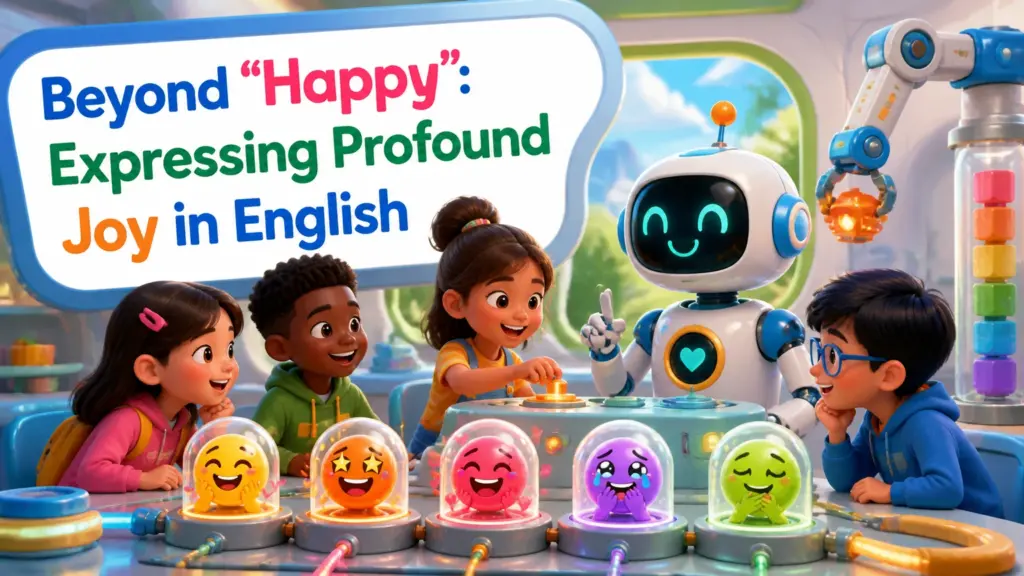

The English language offers a rich tapestry of words to express emotions, and when “happy” simply doesn’t cut it, there’s a wealth of options to convey a deeper sense of joy. Think of feeling ecstatic after receiving wonderful news, like a job offer; being jubilant after your team wins a championship; or utterly blissful during a peaceful vacation. Knowing alternatives such as “delighted,” “thrilled,” “elated,” “overjoyed,” and “ecstatic” allows for more nuanced and impactful communication. This article will explore these alternatives, providing examples and practical guidance to help you articulate profound happiness with precision and flair.
Table of Contents
- Definition: Expressing More Than Happiness
- Structural Breakdown
- Types and Categories of Joyful Expressions
- Examples of Expressing Profound Joy
- Usage Rules
- Common Mistakes
- Practice Exercises
- Advanced Topics
- FAQ
- Conclusion
Definition: Expressing More Than Happiness
Expressing “more than happy” involves using vocabulary that conveys a heightened sense of joy, pleasure, or contentment. It goes beyond the basic emotion of happiness to suggest feelings of elation, excitement, or deep satisfaction. These expressions can be single words (like adjectives such as ecstatic or thrilled), phrases (such as over the moon or on cloud nine), or even idioms that paint a vivid picture of intense happiness. Using a variety of these expressions allows for richer and more engaging communication, enabling you to accurately portray the depth of your emotions.
Structural Breakdown
The structure of expressing profound joy can vary depending on the chosen words or phrases. Here’s a breakdown of common structures:
- Adjective + “to be” verb: I am ecstatic. This is a simple structure where an adjective describing intense happiness follows a form of the verb “to be.”
- Adverb + verb: She beamed with joy. Here, an adverb (often related to happiness) modifies a verb, indicating the manner in which the action is performed.
- Phrase: They were over the moon about the news. This involves using a set phrase that conveys a specific meaning of extreme happiness. These phrases often function as adjectival phrases.
- Idiom: He was walking on air after the promotion. Idioms are figurative expressions where the meaning is different from the literal meaning of the words.
- Exclamatory Sentences: What a delightful surprise! Exclamatory sentences often use intensifiers to emphasize the feeling of joy.
Types and Categories of Joyful Expressions
Adjectives
Adjectives are words that describe nouns. When expressing extreme happiness, adjectives can directly modify nouns or follow a linking verb (such as “to be”) to describe the subject’s state of being. For instance, instead of saying “I am happy,” you might say, “I am thrilled” or “I am delighted.”
Phrases
Phrases are groups of words that function as a single unit within a sentence. Several phrases effectively communicate intense happiness, such as “over the moon,” “on cloud nine,” or “in seventh heaven.” These phrases often act as adjectival phrases, modifying the subject of the sentence.
Idioms
Idioms are expressions whose meanings cannot be understood from the literal meanings of the individual words. They are often figurative and add color to language. Examples include “walking on air,” “tickled pink,” and “happy as a clam.” Understanding idioms is crucial for comprehending nuanced communication and cultural references.
Examples of Expressing Profound Joy
Here are examples of different ways to express more than happiness, categorized by type.
Adjective Examples
Adjectives provide a direct and concise way to describe feelings of intense joy. The following table presents various adjectives and example sentences demonstrating their use.
| Adjective | Example Sentence |
|---|---|
| Ecstatic | She was ecstatic to receive the acceptance letter from her dream university. |
| Thrilled | He was thrilled by the surprise party his friends threw for him. |
| Elated | They were elated when they heard the news of their daughter’s safe arrival. |
| Overjoyed | The parents were overjoyed to see their son graduate with honors. |
| Delighted | I am delighted to hear that you’re coming to visit. |
| Jubilant | The crowd was jubilant after the team won the championship. |
| Blissful | They spent a blissful afternoon relaxing by the beach. |
| Radiant | The bride looked radiant on her wedding day. |
| Exhilarated | He felt exhilarated after completing the challenging hike. |
| Triumphant | The team returned home triumphant after their victory. |
| Contented | She felt contented sitting by the fire with a good book. |
| Merry | The children were merry as they opened their Christmas presents. |
| Cheerful | She was always cheerful, even in difficult situations. |
| Glad | I’m so glad you could make it to the party. |
| Pleased | The teacher was pleased with the students’ progress. |
| Gratified | He felt gratified by the positive feedback he received. |
| Tickled | She was tickled by the funny story he told. |
| Enchanted | They were enchanted by the beautiful scenery. |
| Enthralled | The audience was enthralled by the captivating performance. |
| Rapturous | The crowd gave a rapturous applause after the concert. |
| Upbeat | She maintained an upbeat attitude despite the challenges. |
| Sunny | His sunny disposition always brightened the room. |
| Jolly | The jolly old man told stories to the children. |
| Buoyant | Her buoyant personality lifted everyone’s spirits. |
| Animated | He became quite animated when discussing his favorite topic. |
| Grinning | She was grinning from ear to ear after winning the lottery. |
Phrase Examples
Phrases offer a more descriptive and colorful way to express intense happiness. Here are some phrases and example sentences demonstrating their use.
| Phrase | Example Sentence |
|---|---|
| Over the moon | She was over the moon when she got accepted into her dream school. |
| On cloud nine | They were on cloud nine after their wedding. |
| In seventh heaven | He was in seventh heaven after the birth of his first child. |
| Walking on air | She was walking on air after receiving the promotion. |
| Full of joy | The children were full of joy as they played in the park. |
| Bursting with happiness | She was bursting with happiness when she saw her family after a long time. |
| Tickled pink | She was tickled pink by the thoughtful gift. |
| Happy as can be | He was happy as can be spending time with his grandchildren. |
| Floating on air | After the positive review, the artist was floating on air. |
| In good spirits | Despite the challenges, she remained in good spirits. |
| As pleased as punch | He was as pleased as punch with his team’s performance. |
| Grinning like a Cheshire cat | She was grinning like a Cheshire cat after pulling off the surprise. |
| On top of the world | He felt on top of the world after completing the marathon. |
| Elated beyond words | They were elated beyond words when they won the lottery. |
| Absolutely thrilled | I am absolutely thrilled to be a part of this project. |
| In a joyful mood | Everyone was in a joyful mood during the holiday season. |
| With a spring in one’s step | She walked with a spring in her step after receiving the good news. |
| Beaming with pleasure | He was beaming with pleasure when he saw his artwork displayed. |
| Overjoyed to bits | They were overjoyed to bits at the prospect of their vacation. |
| Jumping for joy | The kids were jumping for joy when they heard about the trip to Disneyland. |
| Happy to the core | She was happy to the core seeing her family all together. |
| Filled with glee | The children were filled with glee as they opened their presents. |
| In high spirits | The team was in high spirits after their victory. |
| In a state of bliss | They were in a state of bliss during their honeymoon. |
Idiom Examples
Idioms add a unique and expressive layer to language, often conveying emotions in a figurative and memorable way. Here are some idioms that express intense happiness, along with example sentences.
| Idiom | Example Sentence |
|---|---|
| Happy as a clam | He was happy as a clam at the beach, building sandcastles all day. |
| Tickled pink | She was tickled pink when she received the beautiful flowers. |
| On top of the world | After acing the exam, he felt on top of the world. |
| Walking on air | She’s been walking on air ever since she got the job offer. |
| In seventh heaven | They were in seventh heaven after the birth of their twins. |
| Over the moon | She was over the moon about the surprise party. |
| As happy as Larry | He’s been as happy as Larry since he retired. |
| Grinning from ear to ear | She was grinning from ear to ear when she saw her birthday present. |
| Like a dog with two tails | He was like a dog with two tails when he heard the good news. |
| Jump for joy | The kids jumped for joy when they found out they were going to Disneyland. |
| Paint the town red | They decided to paint the town red to celebrate their anniversary. |
| Have a whale of a time | We had a whale of a time at the amusement park. |
| Be on cloud nine | She’s been on cloud nine since she started dating him. |
| Be tickled to death | She was tickled to death by the surprise visit from her family. |
| Be in high spirits | The team was in high spirits after winning the championship. |
| Get a kick out of something | He gets a kick out of watching old movies. |
| Be pleased as punch | He was pleased as punch with his team’s performance. |
| Be floating on air | She’s been floating on air since she got engaged. |
Usage Rules
Using expressions of profound joy correctly requires understanding their nuances and contexts. Here are some rules to follow:
- Consider the context: Choose expressions that are appropriate for the situation. For example, “ecstatic” might be suitable for a significant achievement, while “delighted” might be more appropriate for a pleasant surprise.
- Know the intensity: Some expressions are stronger than others. “Overjoyed” and “ecstatic” convey a higher degree of happiness than “pleased” or “contented.”
- Be mindful of formality: Some idioms and phrases are informal and may not be suitable for professional or formal settings. For instance, “happy as a clam” is more informal than “delighted.”
- Use variety: Avoid overusing the same expressions. Varying your vocabulary makes your writing and speech more engaging.
- Pay attention to prepositions: Certain adjectives and phrases are often followed by specific prepositions. For example, “delighted with” or “thrilled by.”
Common Mistakes
Even advanced learners sometimes make mistakes when using expressions of profound joy. Here are some common errors and how to correct them:
| Incorrect | Correct | Explanation |
|---|---|---|
| I am very happy for see you. | I am very happy to see you. | “To see” is the correct infinitive form. |
| She was ecstatic of the news. | She was ecstatic about the news. | “Ecstatic” is followed by “about.” |
| They are over the moon with their new house. | They are over the moon about their new house. | “Over the moon” is followed by “about.” |
| He felt happy than ever. | He felt happier than ever. | Use the comparative form “happier.” |
| I am very glad for you. | I am very glad for you. / I am very happy for you. | Both can be correct, but “happy” is more common in this context. |
| She was in the seventh heaven with her new job. | She was in seventh heaven with her new job. | The correct idiom is “in seventh heaven.” |
| He is walking in air. | He is walking on air. | The correct idiom is “walking on air.” |
| I am thrilling to meet you. | I am thrilled to meet you. | Use the past participle “thrilled.” |
| She was very content. | She was very contented. | “Contented” is the more appropriate form when describing a feeling. |
Practice Exercises
Test your understanding of expressing more than happiness with these exercises.
Exercise 1: Fill in the Blanks
Choose the most appropriate word or phrase from the list to complete each sentence: ecstatic, over the moon, thrilled, delighted, jubilant
| Question | Answer |
|---|---|
| 1. She was __________ to hear that she had won the scholarship. | thrilled |
| 2. The team was __________ after winning the championship game. | jubilant |
| 3. They were __________ with their new puppy. | over the moon |
| 4. I am __________ to accept your invitation. | delighted |
| 5. He was __________ when he found out he was going to be a father. | ecstatic |
| 6. The children were __________ to see the clowns at the circus. | delighted |
| 7. She was __________ that her hard work had finally paid off. | thrilled |
| 8. The fans were __________ as their team scored the winning goal. | jubilant |
| 9. They were __________ when they moved into their dream home. | over the moon |
| 10. I am __________ to have the opportunity to work with such a talented team. | delighted |
Exercise 2: Rewrite the Sentences
Rewrite each sentence using a more expressive adjective or phrase to convey greater happiness.
| Question | Answer |
|---|---|
| 1. I was happy to get the gift. | I was thrilled to get the gift. |
| 2. She was happy about the good news. | She was overjoyed about the good news. |
| 3. They were happy to be on vacation. | They were blissful to be on vacation. |
| 4. He was happy with his new car. | He was delighted with his new car. |
| 5. We were happy to see our friends. | We were ecstatic to see our friends. |
| 6. The kids were happy playing in the snow. | The kids were jubilant playing in the snow. |
| 7. She was happy receiving the award. | She was thrilled receiving the award. |
| 8. They were happy with the surprise. | They were over the moon with the surprise. |
| 9. He was happy about the promotion. | He was elated about the promotion. |
| 10. We were happy to hear the good news. | We were delighted to hear the good news. |
Exercise 3: Idiom Matching
Match the idiom with its correct meaning.
| Idiom | Meaning | Answer |
|---|---|---|
| 1. Happy as a clam | a. Extremely happy and excited | 1-b |
| 2. Walking on air | b. Very content and satisfied | 2-c |
| 3. Over the moon | c. Feeling elated and joyful | 3-a |
| 4. Tickled pink | d. Very pleased and amused | 4-d |
| 5. On cloud nine | e. In a state of perfect happiness | 5-e |
Advanced Topics
For advanced learners, exploring the nuances of expressing profound joy can involve understanding cultural variations and historical contexts. For example, the intensity and appropriateness of certain expressions can vary across cultures. In some cultures, overt displays of extreme happiness may be less common than in others. Additionally, the historical origins of idioms can provide deeper insights into their meanings and usage. Researching the etymology of phrases like “over the moon” or “in seventh heaven” can enrich your understanding and appreciation of the English language.
FAQ
Here are some frequently asked questions about expressing more than happiness:
- Q: What’s the difference between “happy” and “ecstatic”?
A: “Happy” is a general term for feeling pleasure or contentment. “Ecstatic” implies a much stronger feeling of overwhelming joy and delight. It suggests a state of extreme happiness, often associated with a specific event or achievement.
- Q: When should I use idioms instead of simple adjectives?
A: Idioms add color and expressiveness to your language, but they are often informal. Use them in casual conversations and informal writing to make your communication more engaging. In formal settings, stick to more straightforward adjectives.
- Q: Are there any negative connotations to certain expressions of extreme happiness?
A: While most expressions of happiness are positive, it’s important to be mindful of the context. For example, excessively exuberant displays of joy might be perceived as insensitive in situations where others are suffering or experiencing hardship.
- Q: How can I improve my vocabulary for expressing emotions?
A: Read widely, pay attention to how different authors and speakers express emotions, and actively incorporate new words and phrases into your own writing and speech. Use a thesaurus to find synonyms and explore the nuances of different words.
- Q: Is “content” a strong expression of happiness?
A: “Content” implies a state of peaceful satisfaction and contentment. It’s not as intense as “ecstatic” or “overjoyed,” but it suggests a deep sense of fulfillment and well-being. It’s more about inner peace than outward excitement.
- Q: How do I choose the right expression for a specific situation?
A: Consider the context, the intensity of your feelings, and the formality of the situation. If you’re unsure, it’s often best to err on the side of caution and choose a more neutral expression. However, don’t be afraid to experiment and find the words that best capture your emotions.
- Q: What are some common phrases that convey mild happiness?
A: Some common phrases include “feeling good,” “in good spirits,” “pleased with,” and “satisfied with.” These phrases indicate a positive emotional state without suggesting extreme joy.
- Q: Can I use “very happy” in all situations?
A: While “very happy” is grammatically correct and widely understood, it can sometimes sound generic. Using more specific adjectives or phrases can make your communication more impactful and engaging. Consider using alternatives like “delighted,” “thrilled,” or “overjoyed” to add more nuance.
Conclusion
Mastering the art of expressing more than happiness involves understanding the nuances of various adjectives, phrases, and idioms. By expanding your vocabulary beyond the basic “happy,” you can communicate your emotions with greater precision and impact. Remember to consider the context, intensity, and formality of the situation when choosing your words. With practice and attention to detail, you can effectively convey the full spectrum of joy and enhance your communication skills. Exploring expressions such as “ecstatic,” “thrilled,” “over the moon,” and “walking on air” will undoubtedly enrich your language and allow you to articulate your deepest feelings with eloquence.