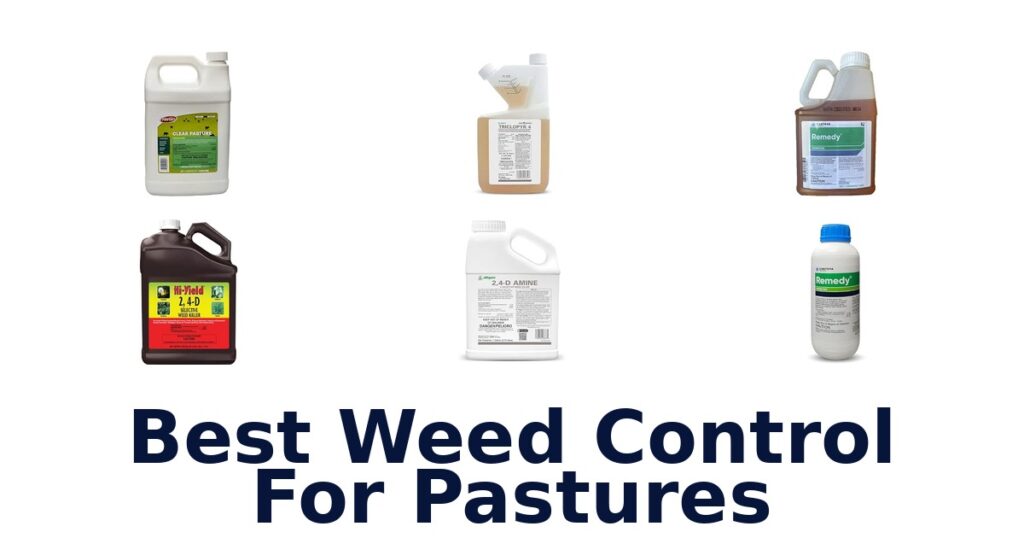

A strong pasture weed control choice targets the weeds you have while fitting your grass, grazing plans, and application site. Corteva DuraCor Herbicide leads this lineup for its stated broadleaf and invasive weed control in pastures, rangeland, CRP acres, and grazing areas, plus residual activity and selective use around established grasses. Other products focus on brush and woody plants, common broadleaf weeds, or thistle, so the best fit depends on the problem rather than a single universal formula.
This comparison covers ten liquid products, including concentrates with triclopyr, 2,4-D amine, and clopyralid. Check the product label for target species, application directions, grazing and haying restrictions, and safety requirements before choosing or applying any herbicide.
Corteva DuraCor Herbicide is the leading pick because its listed uses directly include pastures, rangeland, CRP acres, and grazing areas, while its two active ingredients target tough broadleaf weeds and invasive species. It also states that it preserves established grasses and offers residual activity to help limit regrowth. If brush rather than broadleaf weeds is the main problem, Corteva Remedy Herbicide Concentrate or ALLIGARE Triclopyr 4 may fit better.
Always confirm the label covers your weeds, site, and grazing plan.
Our Top Picks
 Best Overall
Lists pastures, rangeland, CRP acres, and grazing areas; aminopyralid and florpyrauxifen-benzyl target broadleaf weeds while preserving established grasses.
View on Amazon Best Brush Control
Specifically developed for range and pasture, with triclopyr for brush, fence rows, and pasture restoration; the listing identifies a one-gallon product.
View on Amazon Best Woody Plant Focus
Targets woody plants, brush, and broadleaf weeds for pastures and rangelands, with a triclopyr ester formulation and year-round application flexibility.
View on Amazon- Best Broadleaf Range ALLIGARE 2,4-D Amine
- Best Thistle Focus Monterey Thistledown
Compare pasture weed-control options
| # | Product | Weight | Form | Buy |
|---|---|---|---|---|
| 1 | 1. Corteva DuraCor HerbicideBest Overall | 8 lb | Liquid | View on Amazon |
| 2 | 2. Remedy Specialty HerbicideBest Brush Control | 16 oz | Liquid | View on Amazon |
| 3 | 3. ALLIGARE Triclopyr 4Best Woody Plant Focus | 2 lb | Liquid | View on Amazon |
| 4 |  4. ALLIGARE 2,4-D AmineBest Broadleaf Range | 8 lb | Liquid | View on Amazon |
| 5 |  5. Clear Pasture HerbicideTriclopyr for grazing pasture sites | 1 g | Liquid | View on Amazon |
| 6 |  6. Corteva Remedy HerbicideBrush control on pasture edges | 1.1 lb | Liquid | View on Amazon |
| 7 |  7. Monterey ThistledownBest Thistle Focus | 8 oz | Liquid | View on Amazon |
| 8 |  8. Southern Ag Amine 2,4-DBroadleaf control across pasture acreage | 16 oz | Liquid | View on Amazon |
| 9 |  9. Hi-Yield 2,4-D Selective Weed KillerSelective 2,4-D for mixed sites | 4 lb | Liquid | View on Amazon |
| 10 |  10. PBI Gordon Pasture HerbicideBroadleaf control with grazing detail | 9.5 lb | Spray | View on Amazon |
Detailed Reviews: Best Weed Control For Pastures
#1 · Best Overall
1. Corteva DuraCor Herbicide
- Weight: 8 lb
- Form: Liquid
Best for: Residual broadleaf control for forage acres.
Why it ranks #1: Lists pastures, rangeland, CRP acres, and grazing areas; aminopyralid and florpyrauxifen-benzyl target broadleaf weeds while preserving established grasses.
Extended residual activity is the key feature of Corteva DuraCor, intended to help reduce weed regrowth and maintain productive forage acres. It targets many tough broadleaf weeds and invasive species in pastures, rangeland, CRP acres, and grazing areas while helping preserve established grasses.
The two listed active ingredients, aminopyralid at 8.95% and florpyrauxifen-benzyl at 0.76%, identify the formulation, while the product description connects its residual activity with reduced regrowth. That may suit managers seeking continued broadleaf control across forage areas. Its selective targeting is described as helping preserve established pasture and rangeland grasses. The gallon bottle is listed in liquid form; the supplied details do not specify mixing rates or application directions, so label guidance remains necessary.
- Controls many tough broadleaf weeds and invasive species.
- Extended residual activity is intended to help reduce regrowth.
- Listed for pastures, rangeland, CRP acres, and grazing areas.
- Selective targeting helps preserve established grasses.
- The supplied details do not state mixing rates or application directions.
Skip it if you need a stated mix rate in the listing; ALLIGARE 2,4-D Amine provides a 1–2-ounce-per-gallon direction.
This suits pasture and forage managers prioritizing residual broadleaf control and preservation of established grasses across the listed sites. The supplied facts do not provide application rates, so consult the label before planning a treatment.
Full product details
| Brand | Corteva |
|---|---|
| Included Components | Bottle |
| Item Form | Liquid |
| Item Weight | 8 pounds |
| Manufacturer | Corteva Agriscience |
| Model Number | 662974001058 |
Listed on Amazon as: Corteva Agriscience DuraCor Herbicide 1 gal
View on Amazon#2 · Best Brush Control
2. Remedy Specialty Herbicide
- Weight: 16 oz
- Form: Liquid
Best for: Pasture and fence-row brush management.
Why it ranks #2: Specifically developed for range and pasture, with triclopyr for brush, fence rows, and pasture restoration; the listing identifies a one-gallon product.
Low odor and action on both roots and top growth are the distinguishing claims for Remedy Specialty Herbicide. The product is specifically positioned for range and pasture, with uses that include pasture restoration, encroaching brush, fence rows, and general brush control.
The claim that it works on the entire plant, including roots and top growth, gives brush-control buyers a reason to consider it when addressing established vegetation. Its low-odor feature may matter when selecting a product for fence rows or pasture areas where application surroundings are a consideration. It can be used alone or tank mixed with GrazonNext or ForeFront HL, according to the title. The supplied details do not give rates, so consult the label before use.
- Works on roots and top growth, according to the listing.
- Low-odor formulation is stated.
- Listed for pasture restoration and encroaching brush.
- Can be used alone or tank mixed with GrazonNext or ForeFront HL.
- The supplied details do not state application rates.
Skip it if you need named control of Canada thistle and knapweed; Monterey Thistledown lists those targets directly.
This suits pasture owners reclaiming brush-affected areas or maintaining fence rows who value the stated low odor and root-and-top-growth action. Its tank-mix options are named, but application rates still require label guidance.
Full product details
| Brand | Remedy Ultra |
|---|---|
| Included Components | 1 |
| Item Form | Liquid |
| Item Weight | 16 ounces |
| Manufacturer | Dow Argo-Science |
| Model Number | Maryan |
| Additional Information | Important information Safety Information safety_warning Directions Not_Applicable |
Listed on Amazon as: Remedy Specialty Herbicide Weed Killer & Brush Control At Rangeland, Pasture and Fence Lines, Triclopyr Concentrated, Use Alone Or Tank Mix With GrazonNext/ForeFront HL Herbicide, 1 Gallon
View on Amazon#3 · Best Woody Plant Focus
3. ALLIGARE Triclopyr 4
- Weight: 2 lb
- Form: Liquid
Best for: Woody growth across varied sites.
Why it ranks #3: Targets woody plants, brush, and broadleaf weeds for pastures and rangelands, with a triclopyr ester formulation and year-round application flexibility.
ALLIGARE Triclopyr 4 targets woody plants, brush, and broadleaf weeds while its listing says it controls unwanted vegetation without harming grasses. That combination makes it relevant to pasture restoration where grass retention matters, with additional listed uses in forests, rangelands, and industrial sites.
The selective control claim addresses a practical pasture concern: managing brush and broadleaf weeds without harming grasses. Its stated year-round application flexibility offers options across different conditions, while the ester formulation is specifically identified as part of the product’s approach. The liquid format comes in a one-bottle package. The listing does not provide a mixing rate in the supplied facts, so buyers should rely on the label for application instructions and site-specific use.
- Targets woody plants, brush, and broadleaf weeds.
- Listing says it controls vegetation without harming grasses.
- Year-round application flexibility is stated.
- Listed for pastures, forests, rangelands, and industrial sites.
- The supplied details do not provide a mixing rate.
Skip it if you need a stated dilution rate in the listing; ALLIGARE 2,4-D Amine gives a 1–2-ounce-per-gallon direction.
This fits land managers addressing woody growth and broadleaf weeds across pasture and other listed sites while retaining grasses. Choose it when flexible timing is useful, and consult its label for the application rate and directions.
Full product details
| Brand | ALLIGARE |
|---|---|
| Included Components | 1 bottle |
| Item Form | Liquid |
| Item Weight | 2 pounds |
| Manufacturer | ALLIGARE |
| Model Number | Triclopyr 4 EC |
Listed on Amazon as: ALLIGARE – Triclopyr 4 Herbicide Selective Weed Killer for Woody Plants, Brush for Forestry, Pastures, Rights-of-Way, & Industrial Sites – 1 Quart
View on Amazon#4 · Best Broadleaf Range
4. ALLIGARE 2,4-D Amine
- Weight: 8 lb
- Form: Liquid
Best for: Broadleaf weeds with a stated mix rate.
Why it ranks #4: A 47.2% active-ingredient concentrate for pastures that names pigweed, thistle, and ragweed among its broadleaf targets.
A stated 1–2-ounce-per-gallon mixing direction gives ALLIGARE 2,4-D Amine buyers a concrete starting point for preparing the concentrate. The product targets post-emergent broadleaf weeds including pigweed, thistle, and ragweed, and is listed for pastures alongside lawns, aquatic sites, and crops.
The 47.2% active-ingredient specification accompanies a broadleaf-weed focus, including named targets such as pigweed, thistle, and ragweed. That specificity helps buyers compare the listed weed targets with their pasture problem before selecting a treatment. Its listed use sites also extend to lawns, aquatic sites, and crops, although appropriate use depends on the product label. The supplied direction states to mix 1–2 ounces per gallon of water, offering a practical preparation reference absent from many listings.
- Targets broadleaf weeds including pigweed, thistle, and ragweed.
- Identified as a post-emergent herbicide.
- Lists pastures, aquatic sites, lawns, and crops as use sites.
- Provides a 1–2-ounce-per-gallon mixing direction.
- The product is described for broadleaf weeds, not as a general grass-weed control.
Skip it if you need named control of Canada thistle, musk thistle, or knapweed; Monterey Thistledown lists those weeds specifically.
Choose this concentrate when listed broadleaf weeds such as pigweed, thistle, or ragweed are the concern and the stated dilution direction is useful. Check the label to confirm your pasture and target weed are covered.
Full product details
| Brand | ALLIGARE |
|---|---|
| Item Form | Liquid |
| Item Weight | 8 pounds |
| Manufacturer | ALLIGARE |
| Additional Information | Important information Safety Information [GENERIC SAFETY WARNINGS] Directions Mix 1-2 ounces of 2 4-D Amine per gallon of water. |
Listed on Amazon as: ALLIGARE 2,4-D Amine Weed Killer Concentrate – Post-Emergent Herbicide to Control Pigweed, Thistle & More – 47.2% Active Ingredient – for Lawns, Pastures, Aquatic Sites & Crops – 1 Gallon
View on Amazon#5
5. Clear Pasture Herbicide
- Weight: 1 g
- Form: Liquid
Best for: Triclopyr for grazing pasture sites.
Why it ranks #5: Lists grass pastures, rangeland, and CRP among its use sites; its 61.6% triclopyr BEE targets brush, trees, and broadleaf weeds.
A stated triclopyr BEE concentration of 61.6% distinguishes Clear Pasture Herbicide in this group. Its listed uses include grass pastures, rangeland, CRP, and non-irrigation ditch banks, while the supplied grazing information specifies no restrictions except for lactating dairy animals.
The broad site list extends from pasture and rangeland to forests, rights-of-way, non-crop areas, and industrial sites, offering flexibility for properties with multiple vegetation-control needs. The listed targets include woody plants, brush, mesquite, trees, poison oak, ivy, annuals, perennials, and broadleaf weeds. Its grazing note is specific: restrictions do not apply except for lactating dairy animals. Because the details refer users to the label for the complete list, confirm site and application directions there.
- Lists triclopyr BEE at 61.6%.
- Listed for grass pastures, rangeland, and CRP.
- Targets include brush, woody plants, mesquite, and broadleaf weeds.
- Grazing restrictions exclude only lactating dairy animals, according to the listing.
- Lactating dairy animals are excepted from the stated no-grazing-restriction claim.
Skip it if you need named thistle targets and a stated measuring spoon; Monterey Thistledown identifies thistles and includes a spoon.
This fits pasture and rangeland managers targeting brush or listed broadleaf vegetation who need the supplied grazing restriction detail. The exception for lactating dairy animals is important, and the label remains the source for complete directions.
Full product details
| Brand | Control Solutions |
|---|---|
| Included Components | B00A6CKBSS |
| Item Form | Liquid |
| Item Weight | 1 g |
| Manufacturer | Control Solutions |
| Model Number | 2786 |
Listed on Amazon as: Clear Pasture Herbicide
View on Amazon#6
6. Corteva Remedy Herbicide
- Weight: 1.1 lb
- Form: Liquid
Best for: Brush control on pasture edges.
Why it ranks #6: A quart of triclopyr concentrate for permanent grass pastures and rangelands, aimed at encroaching brush and tough broadleaf weeds.
Triclopyr is the key differentiator in Corteva Remedy Concentrate, targeting encroaching brush as well as tough broadleaf weeds. Its listed sites include permanent grass pastures, rangelands, CRP acres, fencerows, and non-irrigation ditch banks, giving land managers several pasture-adjacent areas to address with one herbicide.
The liquid concentrate is identified for brush and weed control throughout the year, which suits buyers managing vegetation that can encroach beyond grazing areas. Its site list spans permanent grass pastures and rangelands as well as fencerows and non-irrigation ditch banks, so it can serve a broader property-maintenance role than a pasture-only listing. The supplied information identifies triclopyr as the active ingredient, but does not provide mixing rates or a full application procedure; use the product label for those details.
- Triclopyr formulation targets brush and broadleaf weeds.
- Listed for permanent grass pastures and rangelands.
- Also listed for CRP acres and fencerows.
- Suitable for non-irrigation ditch banks.
- The supplied details do not state mixing rates or application directions.
Skip it if you need published mixing directions in the listing; ALLIGARE 2,4-D Amine includes a stated mix rate of 1–2 ounces per gallon.
Choose this concentrate if brush and broadleaf weeds are affecting pasture, rangeland, fencerows, or ditch banks. Its listed sites are broad, but the supplied details do not spell out rates, so consult the label before applying.
Full product details
| Brand | Corteva |
|---|---|
| Item Form | Liquid |
| Item Weight | 1.1 pounds |
Listed on Amazon as: Corteva Remedy Herbicide Concentrate, 1 Quart
View on Amazon#7 · Best Thistle Focus
7. Monterey Thistledown
- Weight: 8 oz
- Form: Liquid
Best for: Thistle-focused pasture treatment.
Why it ranks #7: Clopyralid concentrate specifically lists Canada, musk, and star thistle plus knapweed for range and pasture use.
Clopyralid-based, post-emergent control is the defining feature of Monterey Thistledown Concentrate for actively growing broadleaf weeds. Its named targets include Canada thistle, musk thistle, star thistle, and knapweed, making the listing especially useful to buyers comparing products for specific pasture weed problems.
The product is described as selective, with control aimed at actively growing broadleaf weeds rather than presented as a general-purpose vegetation treatment. Its named targets—Canada, musk, and star thistle plus knapweed—help buyers check whether their weed is addressed. The listing also names kudzu, dandelion, and Oxalis. A measuring spoon is included, but the supplied facts do not provide a mixing rate; the use-site information warns against use around ornamentals and vegetables.
- Clopyralid-based post-emergent herbicide.
- Targets actively growing broadleaf weeds and thistle.
- Names Canada, musk, and star thistle and knapweed.
- Measuring spoon is included.
- The listing warns against use around ornamentals and vegetables.
Skip it if you need pasture and fence-row brush control; Corteva Remedy Concentrate lists both sites along with fencerows.
This is a focused option for pasture managers whose actively growing weeds include the listed thistles or knapweed. Its use-site caution around ornamentals and vegetables matters when treated pasture borders gardens or ornamental plantings.
Full product details
| Brand | Monterey |
|---|---|
| Included Components | Measuring spoon |
| Item Form | Liquid |
| Item Weight | 8 ounces |
| Manufacturer | Monterey |
Listed on Amazon as: Monterey Thistledown Weed Killer Concentrate, 8 oz
View on Amazon#8
8. Southern Ag Amine 2,4-D
- Weight: 16 oz
- Form: Liquid
Best for: Broadleaf control across pasture acreage.
Why it ranks #8: A 2,4-D amine concentrate listed for pastures and rangeland, with broadleaf weed and woody plant control and a 1-to-4-pints-per-acre use rate.
A low stated use rate of 1 to 4 pints per acre sets Southern Ag Amine 2,4-D apart for acreage-oriented broadleaf weed control. The liquid concentrate is listed for pastures and rangeland, as well as turf, ditch banks, and fences, making it relevant to mixed-use properties.
The acreage-based rate gives buyers a useful planning reference, while the listed sites connect the product to pasture and adjacent areas such as fences and ditch banks. It controls many broadleaf weeds and woody plants, according to the supplied features. The verified facts identify a low-volatile amine form containing 2,4-D acid equivalent. They also caution users to spray for indicated coverage without overlap and avoid drift to susceptible plants, making careful application an important part of the workflow.
- Stated use rate is 1 to 4 pints per acre.
- Controls many broadleaf weeds and woody plants.
- Listed for pastures and rangeland.
- Also listed for fences and ditch banks.
- Application requires avoiding overlap and drift to susceptible plants.
Skip it if you need a named list of thistle targets; Monterey Thistledown identifies Canada, musk, and star thistle among its controlled weeds.
Consider it for pasture or rangeland broadleaf weeds when the per-acre rate helps plan coverage. It also lists fences and ditch banks, but careful spraying matters: the supplied facts warn against overlap and drift to susceptible plants.
Full product details
| Brand | Southern Ag |
|---|---|
| Included Components | 1 |
| Item Form | Liquid |
| Item Weight | 16 ounces |
| Manufacturer | Southern Ag |
| Model Number | 203 |
| Additional Information | Important information Safety Information safety_warning Directions Not_Applicable |
Listed on Amazon as: Southern Ag Amine 2,4-D WEED KILLER, 32oz – Quart
View on Amazon#9
9. Hi-Yield 2,4-D Selective Weed Killer
- Weight: 4 lb
- Form: Liquid
Best for: Selective 2,4-D for mixed sites.
Why it ranks #9: Lists pastures and rangelands among its use sites and controls many broadleaf weeds, but the supplied details do not name specific pasture targets.
A single selective 2,4-D listing spans pastures, rangelands, lawns, ponds, and drainage ditches, giving Hi-Yield buyers several named sites to consider. It controls many broadleaf weeds and identifies examples including dandelion, arrowhead, buckhorn, aster, and goatsbeard.
The named weed examples provide a practical first check for buyers deciding whether the product matches their pasture problem, while the label is identified as the source for the full weed list. Its listed sites extend beyond pastures to ponds and drainage ditches, which may suit properties with varied treatment areas. Hi-Yield Spreader Sticker is noted as a pairing for increased effectiveness. The supplied details do not give application rates, so application planning requires label directions.
- Selective 2,4-D weed killer.
- Names dandelion, arrowhead, buckhorn, aster, and goatsbeard.
- Listed for pastures and rangelands.
- Hi-Yield Spreader Sticker is noted as a pairing for increased effectiveness.
- The supplied details direct buyers to the label for application rates.
Skip it if you need a stated mixing rate before purchase; ALLIGARE 2,4-D Amine lists a 1–2-ounce-per-gallon direction.
Choose this for a mixed-site property when its listed broadleaf targets and pasture, rangeland, pond, or ditch uses match the job. Check the label for the complete weed list and the application rate.
Full product details
| Brand | Hi-Yield |
|---|---|
| Included Components | Hi-Yield (21416) 2,4-D Selective Weed Killer (1 gal) |
| Item Form | Liquid |
| Item Weight | 4 pounds |
| Manufacturer | VOLUNTARY PURCHASING GROUP |
| Model Number | 21416 |
| Warranty Description | Warranty |
| Additional Information | Important information Safety Information safety_warning Directions Not_Applicable |
Listed on Amazon as: Hi-Yield (21416) 2,4-D Selective Weed Killer, 1 gal
View on Amazon#10
10. PBI Gordon Pasture Herbicide
- Weight: 9.5 lb
- Form: Spray
Best for: Broadleaf control with grazing detail.
Why it ranks #10: The listing identifies pasture use and broadleaf weed and brush control, but provides no active ingredient or specific target weeds to guide selection.
The listing states no waiting between treatment and grazing when sprays have dried, a practical detail for pasture buyers planning livestock access. PBI / Gordon Pasture Herbicide is described for pastures and lawns and is said to eliminate more than 125 species of tough broadleaf weeds and brush.
Its stated coverage of more than 125 species of broadleaf weeds and brush offers a broad target range, though the supplied listing does not name individual weeds. The product is also described as treating one gallon across 2 to 4 acres, which helps buyers estimate area coverage from the stated facts. The grazing note is conditional: there is no waiting between treatment and grazing when used alone once sprays have dried. Confirm application directions on the product label.
- Described for use on pastures and lawns.
- Claims control of over 125 species of broadleaf weeds and brush.
- States one gallon treats 2 to 4 acres.
- No grazing wait when used alone once sprays have dried.
- The supplied details do not name the individual weeds controlled.
Skip it if you need named thistle targets before choosing; Monterey Thistledown lists Canada, musk, and star thistle and knapweed.
This may fit pasture managers valuing the stated acreage coverage and conditional grazing guidance after sprays dry. Its broad weed count is not accompanied by named targets in the supplied details, so check the label for your specific weeds.
Full product details
| Brand | PBI / Gordon |
|---|---|
| Item Form | Spray |
| Item Weight | 9.5 pounds |
| Manufacturer | PBI/GORDON |
| Model Number | 8111072 |
Listed on Amazon as: Pasture Herbicide Gal
View on AmazonAvoiding pasture-treatment failures
The most important failure to avoid is spraying without matching the product label to the weed, site, and grazing plan. These products are not interchangeable: Monterey Thistledown names thistles and knapweed, while the triclopyr products emphasize woody plants, brush, and broadleaf weeds. A product described for pastures does not establish that it controls every weed on a particular property.
Drift is another practical risk: Southern Ag specifically cautions users to avoid drift to susceptible plants and to spray without overlap. ALLIGARE Triclopyr 4 says not to apply if rain is expected within 24 hours, a restriction that should not be generalized to the other products.
Read the full label for application rates, protective equipment, weather limits, grazing or haying intervals, and species restrictions. If the label does not clearly cover the intended site or use, do not assume the product is suitable.
Match the treatment to pasture conditions
The key trade-off is choosing targeted control for a dominant weed problem versus broader control for mixed infestations. Monterey Thistledown has a narrow, clearly named focus on several thistles and knapweed, whereas Corteva DuraCor is described for many tough broadleaf weeds and invasive species across pasture, rangeland, CRP, and grazing areas. Brush-dominated ground points toward triclopyr options such as Remedy Specialty Herbicide or ALLIGARE Triclopyr 4.
Product volume alone is not a reliable measure of acreage coverage: the listings provide no consistent mix rate or treated-area figure for all ten products. PBI Gordon Pasture Herbicide is described as treating one to four acres per gallon, but that claim should not be used to infer coverage for the other products.
Compare the label rate for your weeds and application method before deciding how much concentrate to obtain.
How to Choose Pasture Weed Control
Target weed and active ingredient
Start by identifying whether the main problem is brush, general broadleaf weeds, or a particular weed such as thistle. The products span triclopyr options, including Clear Pasture Herbicide at 61.6% triclopyr BEE, 2,4-D amine products including ALLIGARE 2,4-D Amine at 47.2% active ingredient, and clopyralid in Monterey Thistledown. Corteva DuraCor lists aminopyralid at 8.95% and florpyrauxifen-benzyl at 0.76%.
Those ingredients and percentages do not by themselves establish comparative strength or suitability. Choose a product whose label names your weeds and pasture site: buyers focused on thistle can examine Monterey Thistledown, while brush-focused buyers can compare the triclopyr listings.
Pasture, grass, and grazing fit
Look for explicit pasture use and confirm the label’s limits for desirable plants and livestock. Corteva DuraCor specifically says it selectively targets broadleaf weeds while helping preserve established grasses; ALLIGARE Triclopyr 4 says it can control woody plants and broadleaf weeds without harming grasses. These are product descriptions, not permission to apply under every pasture condition.
Clear Pasture Herbicide lists grazing and haying restrictions, including an exception for lactating dairy animals, while PBI Gordon Pasture Herbicide states no waiting between treatment and grazing when used alone once sprays have dried. Those statements are product-specific and should be checked against the full labels.
Buyers managing grazing animals should prioritize the exact livestock and timing language, while those protecting mixed pasture plants should verify species restrictions before treatment.
Concentrate size and application details
Compare the listed container size and application directions, but do not assume that a larger package covers more land without checking its label rate. The lineup includes quart-size products such as Corteva Remedy Herbicide Concentrate and ALLIGARE Triclopyr 4, an eight-ounce Monterey Thistledown, and gallon-size products such as Corteva DuraCor Herbicide and ALLIGARE 2,4-D Amine. Southern Ag gives a use rate of one to four pints per acre; the supplied details do not provide a directly comparable rate for every option.
A smaller container may suit a targeted treatment if its label rate and allowed use match, while larger listed formats may be more convenient for broader treatment. Verify the mixing, equipment, coverage, and protective-equipment instructions on the label before application.
Which Pasture Herbicide Should You Choose?
For broadleaf weeds across pasture, rangeland, or CRP acres, start with Corteva DuraCor Herbicide: it names those sites, lists two active ingredients, and describes selective use around established grasses. For brush and fence-row encroachment, choose between Remedy Specialty Herbicide, developed for range and pasture, and ALLIGARE Triclopyr 4, which lists woody plants, brush, and pasture restoration. For a focused thistle problem, Monterey Thistledown names several thistle species and knapweed.
ALLIGARE 2,4-D Amine is a clear option to compare when pigweed, thistle, or ragweed are the targets. Southern Ag Amine 2,4-D lists a per-acre rate.
Before purchase or application, confirm the exact weed, pasture site, livestock restrictions, and label directions; the descriptions alone cannot determine a safe application plan.
Frequently Asked Questions
How long after spraying can livestock return to a treated pasture?
There is no single safe return interval for every product. Check the specific herbicide label for grazing restrictions, livestock type, application directions, and any required waiting period. The product titles and descriptions provided here do not establish when animals can return, so do not rely on a general estimate.
Which pasture herbicides can harm clover, legumes, or other desirable plants?
The supplied product information does not specify effects on clover or other legumes for each herbicide. Selectivity claims, such as preserving established grasses, do not establish safety for every desirable plant. Check the exact product label for susceptible species, site restrictions, and directions before treating mixed pasture.
What weather and application conditions reduce herbicide drift or wash-off?
The supplied product details do not give weather limits or rain-free intervals. Before applying, check the selected herbicide’s label for wind, temperature, rainfall, and application guidance. Follow those directions to reduce the chance of drift or wash-off, and postpone treatment if conditions fall outside the label’s instructions.
How should I choose between a broadleaf herbicide and a brush-control product?
Match the product to the main target. DuraCor is the leading pick for broadleaf weeds in pastures, rangeland, or CRP acres. For brush or fence-line encroachment, compare Remedy Specialty and ALLIGARE Triclopyr 4.
Confirm that the label covers the target weed and your site.
What should I verify before applying a product to pasture?
Confirm that the label covers the specific weed and pasture site, and review livestock restrictions and application directions. Product descriptions alone cannot determine a safe treatment plan. For example, the roundup’s editorial guidance identifies Southern Ag Amine 2,4-D as listing a per-acre rate, but the label should govern use.
Final Words
Start with Corteva DuraCor for broadleaf weeds when its label covers your pasture and target species. For brush or fence-line encroachment, compare Remedy Specialty with ALLIGARE Triclopyr 4; consider Monterey Thistledown for a focused thistle problem. Other listings name targets such as pigweed, thistle, or ragweed.
Before choosing or applying any product, verify its label for the site, weeds, livestock restrictions, and directions.