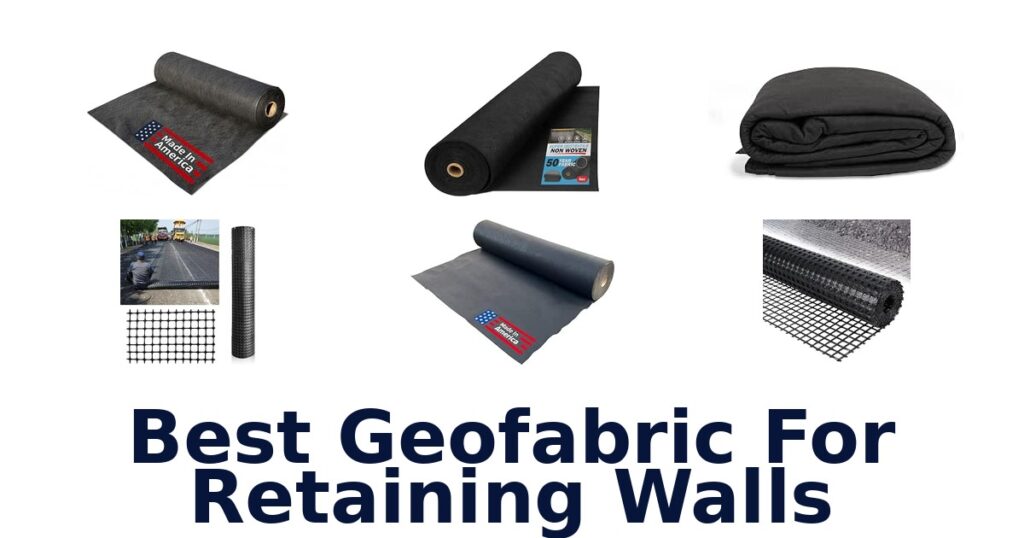

A strong retaining-wall geofabric choice should match the job: nonwoven fabric for filtering and drainage, or geogrid for soil reinforcement. Sandbaggy 8 oz Non Woven Geotextile Fabric is the leading pick here for buyers who want a heavy-duty filter fabric explicitly listed for retaining walls and drainage. The lineup also includes 6 oz fabrics, a 50KN fiberglass grid, and polypropylene mesh in different roll sizes.
Those are not interchangeable products: fabric weight and permeability matter for separating soil from drainage aggregate, while reinforcement grids are intended to help stabilize soil. Compare the intended function, stated material, and roll dimensions before choosing.
Product descriptions provide useful claims, but they do not establish project-specific suitability or replace design requirements for a particular wall.
Sandbaggy 8 oz Non Woven Geotextile Fabric leads because its 8 oz nonwoven polypropylene construction is explicitly listed for retaining walls, drainage, and erosion control. Its 6 ft x 25 ft roll is a practical option when you need a drainage and filter fabric rather than a reinforcement grid. For a project calling for structural soil reinforcement, compare a geogrid such as Yeaborn Retaining Wall Geogrid, which lists 50KN tensile strength and walls up to 6 feet.
Our Top Picks
 Best Overall
Its 8 oz nonwoven polypropylene is explicitly listed for retaining walls and drainage, with a 6 ft x 25 ft roll for filter-fabric applications.
View on Amazon Structural Fabric
The 6 oz nonwoven polypropylene is described for use under retaining walls and lists 350N/m tensile strength and 440kN/m2 load capacity.
View on Amazon Wall-Height Guidance
Yeaborn Retaining Wall Geogrid
This 4 ft x 98 ft fiberglass grid lists 50KN tensile strength and is specified for retaining walls up to 6 feet high.
View on Amazon- High-Flow Fabric Sandbaggy 8 oz Landscape Fabric
- Bidirectional Mesh YUQIPEILEI Bi-Directional Geogrid
Compare Geofabric and Geogrid Options
| # | Product | Material | Buy |
|---|---|---|---|
| 1 | 1. Sandbaggy 8 oz GeotextileBest Overall | Non Woven Polypropylene | View on Amazon |
| 2 | 2. COZONY 6 oz GeotextileStructural Fabric | — | View on Amazon |
| 3 | 3. Yeaborn Retaining Wall GeogridWall-Height Guidance | Fiberglass, Polyester, Polyvinyl Chloride | View on Amazon |
| 4 |  4. Sandbaggy 8 oz Landscape FabricHigh-Flow Fabric | Polypropylene (PP) | View on Amazon |
| 5 |  5. Super Geotextile 6 oz FabricCut-to-Size Wall Drainage | — | View on Amazon |
| 6 |  6. YUQIPEILEI Bi-Directional GeogridBidirectional Mesh | — | View on Amazon |
| 7 |  7. KFURNIKN Bi-Directional GeogridLong-Run Polypropylene Grid | Polypropylene | View on Amazon |
| 8 |  8. Aifukena Retaining Wall GeogridFlexible Fiberglass Wall Grid | Fiberglass, Polyester, Polyvinyl Chloride | View on Amazon |
| 9 |  9. VOLVEX 4 oz GeotextileCompact Drainage Fabric Roll | — | View on Amazon |
| 10 |  10. Aquascape Underlayment FabricPond-Liner Protection Underlay | — | View on Amazon |
Detailed Reviews: Best Geofabric For Retaining Walls
#1 · Best Overall
1. Sandbaggy 8 oz Geotextile
- Material: Non Woven Polypropylene
Best for: Heavy-Duty Drainage Fabric.
Why it ranks #1: Its 8 oz nonwoven polypropylene is explicitly listed for retaining walls and drainage, with a 6 ft x 25 ft roll for filter-fabric applications.
Eight-ounce non-woven polypropylene makes this Sandbaggy roll a substantial filter fabric for retaining walls, with drainage and erosion control among its named applications. Its six-foot width offers broad coverage per run, and the made-in-USA description may appeal to buyers prioritizing stated manufacturing origin alongside a versatile construction fabric.
The 8-ounce non-woven polypropylene construction is specified for drainage and filtering, connecting the fabric to retaining-wall backfill and French-drain work. Its 6-by-25-foot roll provides 150 square feet in a wide, relatively short format, so it can cover broad sections while limiting the roll length to handle. The listing also names road stabilization, erosion control, rip rap, and landscaping, making it applicable beyond a single wall project.
- 8-ounce non-woven polypropylene fabric
- Six-foot width provides broad coverage
- Listed for retaining walls and French drains
- Made in USA, according to the listing
- The 25-foot roll length may not suit long, continuous wall runs.
Skip it if you need a much longer continuous roll; Sandbaggy's 3-by-300-foot non-woven fabric offers substantially more length.
This fits buyers who want heavy non-woven filtration for a retaining wall, French drain, or erosion-control area and can use a six-foot width. Its 25-foot length is the key planning boundary for extended runs.
Full product details
| Brand | Sandbaggy |
|---|---|
| Color | Black |
| Item Dimensions L x W | 300"L x 72"W |
| Item Form | Bolt Of Fabric |
| Manufacturer | Sandbaggy |
| Part Number | 8 oz Non Woven Geotextile Fabric |
| Material | Non Woven Polypropylene |
| Model Number | 8 oz Non Woven Geotextile Fabric |
| Care Instructions | Machine Wash |
Listed on Amazon as: Sandbaggy 8 oz Non Woven Geotextile Fabric, Made in USA Drainage and Filter Fabric for French Drains, Retaining Walls, Erosion Control, Road Stabilization and Landscaping, 6 ft x 25 ft Roll
View on Amazon#2 · Structural Fabric
2. COZONY 6 oz Geotextile
Best for: Measured-Strength Wall Fabric.
Why it ranks #2: The 6 oz nonwoven polypropylene is described for use under retaining walls and lists 350N/m tensile strength and 440kN/m2 load capacity.
A stated 350N/m tensile strength and 440kN/m2 load capacity distinguish this 6-ounce non-woven polypropylene fabric for structural landscape work. The four-by-50-foot roll is specifically listed for retaining walls, road stabilization, drainage, and erosion control, offering a wide format for buyers who need fabric rather than an open geogrid mesh.
The 6-ounce construction pairs with the listed tensile and load figures to support consideration for demanding ground applications, including under retaining walls, concrete, pavers, and road bases. At four feet wide and 50 feet long, the roll offers a middle-sized coverage format for wall sections and related hardscape work. Its non-woven polypropylene material is presented for drainage and erosion control, making it a fabric option where water passage is part of the project brief.
- 6-ounce non-woven polypropylene construction
- 350N/m stated tensile strength
- 440kN/m2 stated load capacity
- Four-by-50-foot roll listed for wall and road uses
- The 50-foot roll is shorter than the listed 98-foot geogrid options.
Skip it if you need a grid for tensile reinforcement rather than filter fabric; Yeaborn's 50KN fiberglass roll is listed for wall stabilization.
This suits buyers seeking a measured-strength non-woven fabric for retaining-wall, paver, or road-base work where drainage matters. Review the project coverage: its four-foot width and 50-foot length may call for multiple runs on larger areas.
Full product details
| Brand | COZONY |
|---|---|
| Item Weight | 7.61 pounds |
| Item model number | bVE-S3Mx-rzRRQZxgURWa0MIb5G1 |
| Manufacturer | COZONY |
| Dimensions | 25.39 x 7.09 x 6.89 inches |
Listed on Amazon as: 6oz Non-Woven Geotextile Fabric 4' x 50', Heavy Duty Landscape Fabric, 350N/m Tensile Strength, 440kN/M2 Load Capacity for Drainage, Road Stabilization & Erosion Control
View on Amazon#3 · Wall-Height Guidance
3. Yeaborn Retaining Wall Geogrid
- Material: Fiberglass, Polyester, Polyvinyl Chloride
Best for: Fiberglass Wall Reinforcement.
Why it ranks #3: This 4 ft x 98 ft fiberglass grid lists 50KN tensile strength and is specified for retaining walls up to 6 feet high.
A 50KN tensile-strength fiberglass geogrid in a 4-by-98-foot roll targets retaining walls up to six feet high, giving buyers a reinforcement format rather than non-woven filter fabric. The listed 392-square-foot coverage supports larger wall or slope projects, while its stated road and pavement uses broaden its role across hardscape groundwork.
The 50KN tensile-force value and fiberglass construction identify this as a grid for ground and wall stabilization, rather than a drainage fabric. At four feet wide and 98 feet long, the roll covers 392 square feet, which can simplify planning for an extended wall run or slope area. The listing also names pavement repair and crack prevention, making it relevant to buyers coordinating wall reinforcement with adjacent road or hardscape work.
- 50KN tensile-force value
- 4-by-98-foot roll covers 392 square feet
- Listed for walls up to six feet high
- Also listed for slope and pavement applications
- The fiberglass geogrid is reinforcement, not non-woven drainage filter fabric.
Skip it if you need a stated high-flow non-woven drainage fabric; Sandbaggy's 8 oz 6-by-25-foot roll is a closer match.
Choose this for a retaining-wall or slope project needing fiberglass grid reinforcement and the stated wall-height range. Its 4-by-98-foot roll suits extended coverage, but buyers seeking drainage filtration should select a non-woven fabric instead.
Full product details
| Brand | Yeaborn |
|---|---|
| Color | Black |
| Item Dimensions | 1176 x 48 x 0.12 inches |
| Item Form | Retaining Wall Geogrid Roll |
| Dimensions | 1176 x 48 x 0.12 inches |
| Manufacturer | Yeaborn |
| Material | Fiberglass, Polyester, Polyvinyl Chloride |
#4 · High-Flow Fabric
4. Sandbaggy 8 oz Landscape Fabric
- Material: Polypropylene (PP)
Best for: High-Flow Fabric for Long Runs.
Why it ranks #4: Its 8 oz nonwoven polypropylene is listed for retaining walls and drainage, with a stated flow rate of 110 GPM per square foot.
A stated flow rate of 110 gallons per square foot per minute pairs with 8-ounce non-woven polypropylene construction, making this Sandbaggy fabric a drainage-focused option for retaining walls. The three-foot-by-300-foot roll offers substantial length for extended projects, though its narrower width requires careful coverage planning.
The listed 205-pound tensile strength and 8-ounce fabric construction speak to a heavy-duty non-woven material, while the 110 GPM-per-square-foot flow figure supports its stated drainage role. At three feet wide and 300 feet long, it can supply a continuous run across a long project, but broad wall areas may require multiple adjacent runs. The listed uses also include French drains, rip rap, weed mat, and ground cover.
- 8-ounce non-woven polypropylene fabric
- Listed 110 GPM per square foot flow rate
- Stated 205-pound tensile strength
- Three-by-300-foot roll for extended runs
- Three-foot width can require multiple runs across wide areas.
Skip it if you need a wider fabric roll for broad sections; Sandbaggy's 8 oz 6-by-25-foot non-woven fabric provides a six-foot width.
This is a strong format match for buyers needing long runs of drainage fabric around retaining walls or French drains. Its 300-foot length is useful for continuity, while the three-foot width needs to suit the site layout.
Full product details
| Brand | Sandbaggy |
|---|---|
| Color | Black |
| Item Form | Cut By The Yard |
| Manufacturer | Sandbaggy |
| Material | Polypropylene (PP) |
Listed on Amazon as: Sandbaggy Non Woven 8 oz Geotextile Landscape Fabric | Toughest on the Market | Weed Mat, Ground Cover, Garden Tarp, French Drains, Rip Rap, Retaining Walls (3 ft x 300 ft Roll)
View on Amazon#5
5. Super Geotextile 6 oz Fabric
Best for: Cut-to-Size Wall Drainage.
Why it ranks #5: The 6 oz nonwoven filter fabric is described as heavy duty, dimensionally stable, and suited to demanding projects, though its listed features are less wall-specific.
A single 3-by-50-foot piece of 6-ounce non-woven geotextile gives retaining-wall projects a substantial filter-fabric roll without requiring multiple joined sections. Its heavy-duty construction and stated UV and rot resistance suit outdoor use, while the listed size can help limit scraps when it matches the dimensions of your drainage or separation area.
The 6-ounce weight and non-woven construction are the central choices here: the product describes the fabric as high-strength, making it relevant for demanding drainage and filter applications around a wall. Its 3-by-50-foot format provides one continuous piece, and the brand says it stocks sizes to reduce scrap when a piece can be cut to the needed dimensions. UV and rot resistance support long-term outdoor placement, though the roll is only three feet wide.
- 6-ounce heavy-duty non-woven fabric
- 3-by-50-foot single-piece roll
- Stated UV and rot resistance
- Promoted for drainage and filtering
- Three-foot width may require additional coverage for wider installations.
Skip it if you need a 4-foot-wide reinforcement grid; Yeaborn's 4-by-98-foot fiberglass geogrid is the more relevant format.
This suits buyers seeking non-woven filter fabric for a retaining-wall drainage project that can use a three-foot-wide roll. Check the required coverage and installation plan: this is filter fabric, not the listed fiberglass reinforcement grid.
Full product details
| Brand | Super Geotextile |
|---|---|
| Item Weight | 8 pounds |
| Item model number | 43237-2 |
| Manufacturer | Super Geotextile |
| Package Dimensions | 36.5 x 6 x 5.7 inches |
Listed on Amazon as: Super Geotextile Non Woven Geotextile Fabric 6 Oz 3x50Ft, Filter Fabric
View on Amazon#6 · Bidirectional Mesh
6. YUQIPEILEI Bi-Directional Geogrid
Best for: Two-Way Soil Stabilization.
Why it ranks #6: Its polypropylene mesh is specifically presented for retaining-wall backfill reinforcement, with a bidirectional structure intended to distribute loads.
Bi-directional polypropylene mesh provides tensile strength in both directions, helping distribute loads across retaining-wall backfill and other ground-stabilization areas. The 3.3-by-50-foot roll is also listed for driveways, erosion control, and landscaping, while stated resistance to UV exposure, chemicals, moisture, and aging supports its intended outdoor use.
The bi-directional structure is described as distributing stress and helping lock aggregate and soil together, which can reduce shifting in wall backfill and improve base stability. Polypropylene construction is listed with resistance to UV exposure, chemicals, moisture, and aging, supporting outdoor placement. At 3.3 feet wide and 50 feet long, the roll suits narrower runs, but buyers should account for its width when mapping a broader wall area.
- Bi-directional grid structure
- Polypropylene mesh for outdoor use
- Listed resistance to UV, chemicals, and moisture
- Uses include wall backfill and driveway bases
- At 3.3 feet wide, the roll is narrower than four-foot options.
Skip it if you need a four-foot-wide roll for broader coverage; KFURNIKN's 4-by-164-foot bi-directional grid is a wider option.
This suits buyers reinforcing a retaining-wall backfill, driveway base, or landscaped slope who value a two-direction grid structure. Its 3.3-foot width is a practical boundary to factor into layout and coverage calculations.
Full product details
| Brand | YUQIPEILEI |
|---|---|
| Color | black |
| Manufacturer | YUQIPEILEI |
| Part Number | 1 roll |
| Model Number | geogrid mesh |
| Product Style | Modern |
| Style | Modern |
Listed on Amazon as: 3.3ft x 50ft Bi-Directional Geogrid Mesh Roll, Polypropylene Geogrid for Ground Stabilization, Retaining Wall Reinforcement, Driveway Base, Erosion Control and Landscape Support
View on Amazon#7
7. KFURNIKN Bi-Directional Geogrid
- Material: Polypropylene
Best for: Long-Run Polypropylene Grid.
Why it ranks #7: The polypropylene reinforcement mesh is listed for retaining walls and measures 4 ft x 164 ft, providing an extended roll for larger projects.
A four-foot-wide, 164-foot-long bi-directional polypropylene geogrid offers extended coverage for retaining walls, driveways, paths, and terraces. Its listed UV and chemical resistance addresses outdoor exposure, while the mesh format gives buyers a reinforcement option for larger ground-stability projects rather than a non-woven drainage filter fabric.
The 4-by-164-foot size provides 656 square feet of grid, useful when laying out a long wall or several connected ground-reinforcement areas. Its bi-directional structure is named in the title, and polypropylene construction is specified for the mesh. The listing also identifies UV and chemical resistance, relevant to outdoor installation, and calls out garden paths, terraces, parking lots, and driveways alongside retaining walls.
- Four-foot width and 164-foot roll length
- Bi-directional geogrid mesh
- Polypropylene construction
- Listed UV and chemical resistance
- The listing provides no tensile-strength value for comparing reinforcement capacity.
Skip it if you need a stated 50KN tensile value; Yeaborn's 4-by-98-foot fiberglass geogrid lists that specification.
This fits buyers covering long retaining-wall, driveway, or terrace runs who want a broad polypropylene mesh roll. The listing emphasizes size and outdoor resistance, but does not supply a tensile-strength figure for technical comparison.
Full product details
| Brand | KFURNIKN |
|---|---|
| Color | Pure Black |
| Item Form | Mesh |
| Manufacturer | KFURNIKN |
| Material | Polypropylene |
Listed on Amazon as: 4X164ft Bi-Directional Geogrid for Retaining Wall, Driveway
View on Amazon#8
8. Aifukena Retaining Wall Geogrid
- Material: Fiberglass, Polyester, Polyvinyl Chloride
Best for: Flexible Fiberglass Wall Grid.
Why it ranks #8: This 4 ft x 98 ft fiberglass, polyester, and PVC grid lists a 50KN tensile force value and is intended for slope reinforcement and pavement maintenance.
A 4-by-98-foot fiberglass geogrid with a stated 50KN tensile-force value targets long retaining-wall and slope reinforcement runs. Aifukena also describes the grid as lightweight and flexible, attributes that may ease handling across a large area, while its listed road expansion and pavement maintenance uses suit projects combining wall work with nearby surfaces.
The 50KN tensile-force figure and fiberglass material identify a reinforcement grid for retaining walls, while the four-foot width and 98-foot length provide 392 square feet of coverage. That extended roll can support planning for longer wall or slope sections with fewer roll changes. The product also lists road expansion and pavement maintenance, making it relevant where a buyer needs one grid format across connected ground-reinforcement tasks.
- Stated 50KN tensile-force value
- 4-by-98-foot roll provides 392 square feet
- Fiberglass, polyester, and PVC listed as materials
- Described as lightweight and flexible
- The listing does not state a wall-height limit for this grid.
Skip it if you need a listed wall-height rating; Yeaborn's 4-by-98-foot geogrid specifies walls up to six feet high.
This is a fit for buyers planning extended retaining-wall, slope, or pavement reinforcement with a fiberglass grid. Its stated size and tensile value are useful planning details, but the listing gives no wall-height limit to guide structural selection.
Full product details
| Brand | Aifukena |
|---|---|
| Color | Black |
| Item Dimensions | 1176 x 48 x 0.12 inches |
| Item Form | Offers excellent tensile strength, light weight, strong flexibility, and long service life. |
| Dimensions | 1176 x 48 x 0.12 inches |
| Manufacturer | Aifukena |
| Material | Fiberglass, Polyester, Polyvinyl Chloride |
| Model Number | 4' x 98' |
Listed on Amazon as: Retaining Wall Geogrid – Geogrid for Retaining Walls,4' x 98' Fiberglass Tensile Force Value 50KN,Ideal for Slope Reinforcement,Road Expansion and Pavement Maintenance
View on Amazon#9
9. VOLVEX 4 oz Geotextile
Best for: Compact Drainage Fabric Roll.
Why it ranks #9: The 4 oz fabric is listed for retaining walls and drainage, with 450N tensile strength and a 1500N load limit, but less weight than the heavier fabric options.
A 3-by-50-foot, 4-ounce non-woven geotextile gives smaller retaining-wall and French-drain jobs a compact fabric roll with listed tensile strength of 450N and a 1500N load limit. Its permeable construction supports drainage applications, while the moderate roll length can be easier to plan around limited coverage needs.
The non-woven geotextile is described as permeable, connecting its material construction to drainage use beneath pavement and around retaining walls. Its 450N tensile-strength and 1500N load-limit figures provide two stated performance measures for project comparison. The three-foot-by-50-foot format supplies 150 square feet, which can suit a shorter wall section or walk path without committing to a very long roll.
- Permeable non-woven geotextile
- 450N stated tensile strength
- 1500N stated load limit
- Three-by-50-foot roll for smaller areas
- At four ounces, it is lighter than the listed 6- and 8-ounce fabrics.
Skip it if you want an 8-ounce fabric for heavier-duty filtration; Sandbaggy's 8 oz 6-by-25-foot roll is a heavier option.
This suits buyers covering a modest retaining-wall, drainage, or walk-path area who want stated tensile and load figures. Its four-ounce weight and three-foot width should match the intended duty and coverage plan.
Full product details
| Brand | VOLVEX |
|---|---|
| Item Weight | 5.64 pounds |
| Item model number | VG4 3-50 |
| Manufacturer | Volvex |
| Dimensions | 36 x 5.5 x 5.5 inches |
#10
10. Aquascape Underlayment Fabric
Best for: Pond-Liner Protection Underlay.
Why it ranks #10: The 5 ft x 10 ft underlayment is listed for retaining walls, but its primary stated purpose is protecting pond liners from rocks, roots, and uneven soil.
A flexible, heavy-duty underlayment about 30% thicker than standard is intended to shield pond liners from sharp rocks, roots, and uneven soil. Aquascape also lists retaining walls, drainage, and landscaping among its uses, making this compact five-by-ten-foot sheet relevant where liner protection and small-area ground coverage overlap.
The underlayment’s stated role is protection against sharp rocks, roots, and uneven soil, which makes it particularly relevant beside a pond or waterfall incorporated into a landscape with retaining walls. Its flexible construction is described as easy to handle during installation, and the five-by-ten-foot size provides 50 square feet for localized coverage. The listed drainage and weed-barrier applications broaden its use, but this format is not a long wall-run roll.
- About 30% thicker than standard underlayment
- Protects liners from rocks, roots, and uneven soil
- Flexible and described as easy to handle
- Five-by-ten-foot format covers 50 square feet
- Five-by-ten-foot coverage is limited for long retaining-wall runs.
Skip it if you need continuous fabric for a long wall run; Sandbaggy's 3-by-300-foot non-woven roll offers far more length.
This fits pond owners and landscapers needing localized underlayment or drainage coverage near a retaining wall. Its liner-protection role and compact dimensions suit small areas, not extensive wall drainage or reinforcement runs.
Full product details
| Brand | Aquascape |
|---|---|
| Item Weight | 2.86 pounds |
| Item model number | 42135 |
| Manufacturer | Aquascape, Inc. |
| Dimensions | 60 x 120 x 0.25 inches |
Listed on Amazon as: Aquascape Heavy-Duty Geotextile Underlayment Fabric, 5 Feet x 10 Feet – Durable Landscaping & Drainage Liner for Ponds, Waterfalls, Retaining Walls, Weed Barrier, 42135
View on AmazonWhy filter fabric and reinforcement grid are not substitutes
Filter fabric and reinforcement grid perform different jobs, so choosing by the word retaining wall alone can lead to a mismatch. Nonwoven geotextiles in this lineup are described as drainage or filter fabrics; examples include the 8 oz polypropylene Sandbaggy 8 oz Geotextile and the 6 oz COZONY 6 oz Geotextile. Geogrids, including the 50KN fiberglass Yeaborn Retaining Wall Geogrid and polypropylene YUQIPEILEI Bi-Directional Geogrid, are presented for soil or backfill reinforcement.
A wall design may require one function or both, but these product details do not confirm a specific design. A common failure mode is treating fabric as a substitute for reinforcement, or assuming grid alone will filter fine soil from drainage aggregate.
Check the wall plan and drainage details to identify the intended role of each layer. Do not infer structural capacity from fabric weight, or permeability from a grid’s tensile-strength claim.
Plan roll dimensions around the wall and drainage layer
Roll dimensions can create waste or leave gaps if you estimate coverage from wall face area alone. For instance, Sandbaggy 8 oz Geotextile measures 6 ft x 25 ft, while COZONY 6 oz Geotextile is 4 ft x 50 ft; the listed sizes differ in width and length even though both are fabric rolls. The 3 ft x 300 ft Sandbaggy 8 oz Landscape Fabric gives a very different format, and grid rolls such as Yeaborn Retaining Wall Geogrid measure 4 ft x 98 ft.
For estimating, include the portions that wrap or separate drainage aggregate and account for seams and overlaps required by the project design. The product data does not state a recommended overlap, wall-backfill layout, or how much area each roll will cover after installation.
Measure the actual installation path and check the specified layer arrangement before ordering; nominal roll area alone does not establish usable coverage.
How to Choose Retaining-Wall Geofabric
Choose fabric or reinforcement grid
Start by identifying whether the wall needs filtration and drainage, soil reinforcement, or both. Nonwoven filter fabrics such as Sandbaggy 8 oz Geotextile and COZONY 6 oz Geotextile are described for drainage or retaining-wall applications, while Yeaborn Retaining Wall Geogrid is a fiberglass reinforcement grid with a stated 50KN tensile strength. YUQIPEILEI Bi-Directional Geogrid is also presented for backfill reinforcement.
These product types serve distinct functions, so do not use a fabric’s ounce weight as a substitute for a grid strength specification. Buyers following a design that calls for filtering should compare the fabric options; buyers whose plans specify reinforcement should focus on the grid products and the design’s required strength and placement.
Compare fabric weight and stated performance
For filter fabric, compare the listed weights and performance claims, while remembering that weight alone does not prove suitability. The lineup includes 4 oz VOLVEX 4 oz Geotextile, 6 oz Super Geotextile 6 oz Fabric and COZONY 6 oz Geotextile, and 8 oz options from Sandbaggy. COZONY lists 350N/m tensile strength and 440kN/m2 load capacity; VOLVEX lists 450N tensile strength and a 1500N load limit.
Sandbaggy 8 oz Landscape Fabric states a flow rate of 110 GPM per square foot. Buyers prioritizing heavier listed fabric can compare the 8 oz options, while a smaller or lighter-duty project may consider 4 oz or 6 oz products only if they meet its design requirements.
Confirm compatible filtration and strength requirements rather than assuming these claims are directly comparable.
Match roll format to the installation
Choose a roll width and length that suit the planned layer layout, not just the wall’s visible face. Listed formats range from Aquascape Underlayment Fabric at 5 ft x 10 ft to Sandbaggy 8 oz Geotextile at 6 ft x 25 ft, COZONY 6 oz Geotextile at 4 ft x 50 ft, and Yeaborn Retaining Wall Geogrid at 4 ft x 98 ft. KFURNIKN Bi-Directional Geogrid lists a longer 4 ft x 164 ft roll.
A short, contained task may suit a smaller roll; a longer wall or repeated installation may benefit from greater listed length. Account for the backfill and drainage layer, seams, cuts, and any specified returns or overlaps.
Product dimensions do not state usable coverage after those details, so measure the planned installation and check the project requirements before selecting a format.
Which Retaining-Wall Geofabric Should You Choose?
For a retaining-wall drainage or filtration layer, choose Sandbaggy 8 oz Geotextile: it is explicitly listed for retaining walls and drainage, and its 8 oz nonwoven polypropylene construction makes it the strongest all-around fabric fit in this lineup. If your project specifies a 6 oz structural fabric and stated strength values matter, consider COZONY 6 oz Geotextile. If the design calls for grid reinforcement and sets a wall height of up to 6 feet, compare Yeaborn Retaining Wall Geogrid, which lists 50KN tensile strength.
For a high-flow fabric roll, Sandbaggy 8 oz Landscape Fabric states 110 GPM per square foot. Use the product type and values required by the wall design; none of these listings alone confirms suitability for every wall.
Frequently Asked Questions
Should retaining-wall backfill use geotextile fabric, geogrid, or both?
Use both only when the wall design calls for both functions: geotextile provides drainage and filtration, while geogrid supplies soil reinforcement. The listed Sandbaggy fabric is explicitly identified for retaining walls and drainage; the Yeaborn grid lists 50KN tensile strength and walls up to six feet. Select by design, not as interchangeable products.
How much overlap should geofabric have at seams and around drainage aggregate?
There is no overlap amount established by these listings; follow the wall plan or fabric manufacturer’s installation instructions. The required seam overlap can depend on the specified assembly and site conditions. Keep geotextile positioned to separate soil from drainage aggregate as directed, and do not substitute a guessed dimension for the design.
Which side of a retaining-wall geotextile should face the soil?
Follow the product instructions or wall specification; the supplied listings do not establish a soil-facing side. Do not assume that a particular side must face soil based on a product title alone. If the instructions are unclear, confirm the orientation with the supplier or the person responsible for the wall design before installation.
When should I choose geogrid instead of geotextile fabric?
Choose geogrid when the wall design specifies structural soil reinforcement. The editorial verdict identifies Yeaborn Retaining Wall Geogrid as an option listing 50KN tensile strength and walls up to six feet. Choose a geotextile when the specified role is drainage or filtration; a fabric listing does not establish that it replaces reinforcement.
What product details should I match to my wall design?
Match the specified product type and required values to the wall design. The listings include fabric weights, dimensions, and stated strength or flow values, but those details do not confirm suitability for every wall. Check the design requirements first, then compare only the relevant listing details and verify any unresolved requirements.
Final Words
Start with the wall design’s required function: drainage and filtration point toward geotextile, while structural soil reinforcement points toward geogrid. For a drainage or filter fabric explicitly listed for retaining walls, the verdict favors Sandbaggy 8 oz Non Woven Geotextile. If reinforcement is specified, compare the listed grid values and wall-height limits against the design.
Treat product listings as comparison information, not confirmation of suitability for every wall.