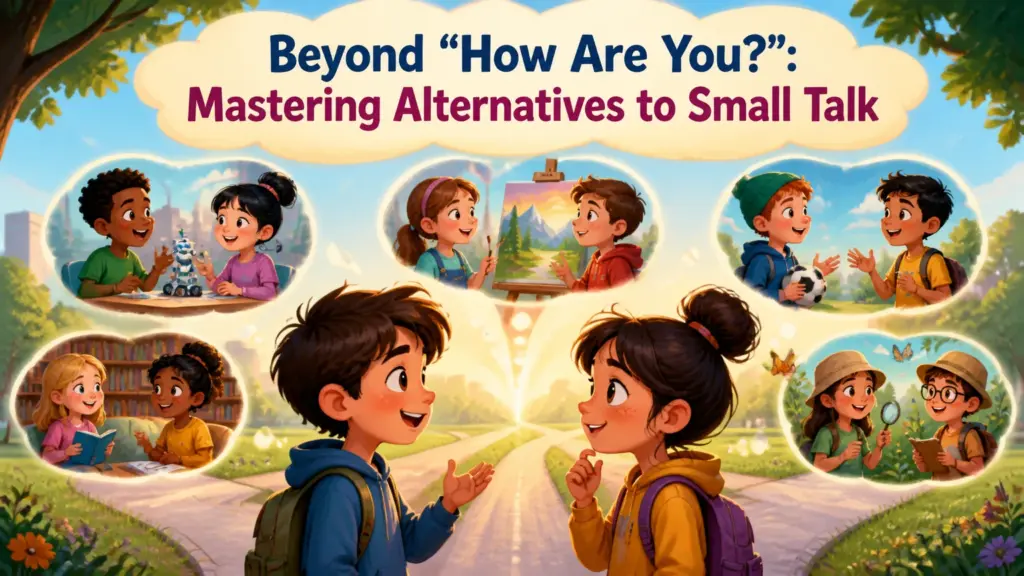

Small talk, often characterized by superficial inquiries and predictable responses, serves as a social lubricant in many contexts. However, its limitations become apparent when seeking more meaningful connections. Instead of relying on generic greetings such as “How’s the weather?” or “Busy day?”, exploring alternative conversation starters can lead to more engaging and insightful interactions. Phrases that encourage reflection, like “What’s been inspiring you lately?” or questions that reveal passions, such as “What are you working on that you’re excited about?”, can transform mundane exchanges into opportunities for genuine connection. Mastering these alternatives is beneficial for professionals networking, individuals building relationships, and anyone seeking to elevate their social interactions beyond the superficial. By shifting the focus from routine inquiries to more thoughtful prompts, we can cultivate deeper, more rewarding conversations.
Table of Contents
- What is Small Talk?
- Limitations of Traditional Small Talk
- Alternatives to Small Talk
- Examples of Alternative Conversation Starters
- Rules for Effective Alternative Small Talk
- Common Mistakes to Avoid
- Practice Exercises
- Advanced Techniques
- Frequently Asked Questions
- Conclusion
What is Small Talk?
Small talk is a light, informal conversation used to fill the silence, build rapport, or ease social interactions. It typically avoids controversial or deeply personal topics, focusing instead on safe, neutral subjects. The primary purpose of small talk is to establish a connection and create a comfortable atmosphere, rather than to delve into substantive discussions. It’s a social tool that helps us navigate initial encounters and maintain relationships without requiring intense emotional or intellectual engagement.
Small talk serves several important functions in social interaction. It provides a buffer in situations where silence might be awkward, such as waiting in line, attending a networking event, or meeting someone for the first time. It also acts as a preliminary step towards deeper conversations. By engaging in small talk, individuals can assess each other’s personalities, interests, and communication styles before committing to more meaningful exchanges. Furthermore, small talk can reinforce social bonds by demonstrating politeness, interest, and a willingness to connect.
Limitations of Traditional Small Talk
While small talk is a valuable social tool, it has limitations. Its superficial nature can lead to repetitive and uninspiring conversations, hindering the development of genuine connections. Traditional small talk often revolves around predictable topics like the weather, current events (handled delicately), or generic inquiries about one’s well-being. These exchanges, while polite, rarely offer opportunities for meaningful self-expression or mutual discovery.
Another limitation is that small talk can feel disingenuous or forced, especially for individuals who prefer deeper, more substantive conversations. Engaging in repetitive, surface-level exchanges can be draining and unsatisfying, leading to a sense of disconnection or boredom. Furthermore, small talk can perpetuate social barriers by reinforcing superficial impressions and preventing individuals from revealing their authentic selves. Over-reliance on traditional small talk can, therefore, hinder the development of strong, meaningful relationships.
Alternatives to Small Talk
To overcome the limitations of traditional small talk, exploring alternative conversation starters is essential. These alternatives focus on fostering genuine connection, encouraging self-expression, and revealing shared interests. They move beyond superficial inquiries and delve into topics that are more engaging, insightful, and personally relevant.
Open-Ended Questions
Open-ended questions require more than a simple “yes” or “no” answer. They encourage the other person to elaborate, share their thoughts and feelings, and express their unique perspective. By asking open-ended questions, you create space for more meaningful and engaging conversations.
Focusing on Passions and Interests
Instead of asking generic questions about work or daily routines, focus on uncovering the other person’s passions and interests. Asking about hobbies, creative projects, or personal goals can reveal their true self and spark more engaging conversations. People are generally enthusiastic about sharing what they are passionate about, making this approach highly effective.
Discussing Current Events (Carefully)
While potentially sensitive, discussing current events can be a good alternative to stale small talk, provided you approach the topic with sensitivity and respect. Avoid controversial or divisive subjects, and focus instead on news items that are positive, interesting, or relevant to both parties. Frame your questions in a way that encourages thoughtful discussion rather than debate.
Highlighting Positive Topics
Focusing on positive topics can create a more uplifting and enjoyable conversation. Instead of dwelling on complaints or negative experiences, steer the conversation towards things you appreciate, things you’re grateful for, or things that bring you joy. This approach can foster a more positive and optimistic atmosphere.
Referring to Shared Experiences
If you share a common experience with the other person, such as attending the same event, working on the same project, or belonging to the same group, referring to that experience can be a great way to initiate a conversation. This creates an immediate connection and provides a shared context for discussion.
Examples of Alternative Conversation Starters
Here are some examples of alternative conversation starters, categorized by context, to help you move beyond traditional small talk and foster more meaningful connections.
Icebreaker Questions
These questions are designed to break the ice and encourage people to share interesting or unusual information about themselves.
The following table includes a variety of icebreaker questions designed to be engaging and thought-provoking, along with potential response categories. These questions aim to stimulate conversation beyond typical small talk.
| Icebreaker Question | Possible Response Categories |
|---|---|
| What’s a skill you’d love to learn? | Musical instrument, foreign language, coding, culinary skill, artistic skill |
| What’s the best piece of advice you’ve ever received? | Career advice, relationship advice, personal growth advice, financial advice |
| What’s a book, movie, or TV show that has significantly impacted you? | Fiction, non-fiction, documentary, drama, comedy |
| If you could have any superpower, what would it be? | Flying, invisibility, telepathy, super strength, time travel |
| What’s a place you’ve always wanted to visit? | Historical site, natural wonder, bustling city, tropical island, remote wilderness |
| What’s your favorite way to spend a free afternoon? | Reading, hiking, cooking, crafting, socializing |
| What’s a small thing that always makes you smile? | Pet antics, a kind gesture, a beautiful sunset, a good cup of coffee |
| What’s a cause you’re passionate about? | Environmental protection, animal welfare, social justice, education, healthcare |
| What’s a recent accomplishment you’re proud of? | Professional achievement, personal milestone, skill improvement, overcoming a challenge |
| If you could have dinner with any historical figure, who would it be? | Scientist, artist, politician, philosopher, writer |
| What’s a unique or quirky hobby you have? | Collecting, crafting, gaming, outdoor activity, unusual sport |
| What’s the most interesting thing you’ve learned recently? | Scientific discovery, historical fact, cultural insight, new technology |
| What’s a goal you’re currently working towards? | Career advancement, personal fitness, skill development, travel planning |
| What’s a song that always puts you in a good mood? | Upbeat pop, classic rock, soulful blues, energetic dance track |
| What’s a tradition you cherish? | Family holiday, annual event, cultural celebration, personal ritual |
| What’s something you’re looking forward to? | Upcoming vacation, social event, project completion, personal milestone |
| What’s your favorite type of cuisine to cook or eat? | Italian, Mexican, Asian, Mediterranean, Vegetarian |
| What’s a simple pleasure you enjoy every day? | Morning coffee, evening walk, listening to music, spending time with loved ones |
| What’s a challenge you’ve overcome that made you stronger? | Personal hardship, professional setback, financial struggle, health issue |
| What’s a skill you wish you had learned earlier in life? | Financial literacy, public speaking, self-defense, cooking, a musical instrument |
| What’s an app that you find yourself using most often? | Social media, productivity, entertainment, health and fitness |
| What’s a podcast that you enjoy listening to? | News, comedy, educational, storytelling, true crime |
| What’s a funny or embarrassing moment you can laugh about now? | Public speaking mishap, clumsy accident, social faux pas |
| What’s a way you like to give back to the community? | Volunteering, donating, mentoring, advocacy |
| What’s a new habit you’re trying to develop? | Exercise routine, meditation, journaling, healthy eating |
| What’s a topic you’re currently trying to learn more about? | History, science, technology, art, personal finance |
Work-Related Alternatives
These questions can be used in professional settings to initiate conversations beyond typical work-related topics.
The table below presents work-related conversation starters designed to move beyond routine discussions. These questions are formulated to encourage creativity, share insights, and build professional rapport.
| Work-Related Conversation Starter | Possible Response Categories |
|---|---|
| What’s a project you’re currently excited about? | Innovative project, challenging task, collaborative effort |
| What’s a skill you’re trying to develop to improve your work? | Technical skill, communication skill, leadership skill, time management skill |
| What’s a recent industry trend you’ve found interesting? | Technological advancement, market shift, regulatory change, consumer behavior |
| What’s a piece of advice that has helped you in your career? | Mentorship advice, leadership insight, strategic guidance, personal development |
| What’s a tool or software that has greatly improved your productivity? | Project management software, communication platform, design tool, data analysis software |
| What’s a work-related challenge you’ve recently overcome? | Technical obstacle, team conflict, tight deadline, resource limitation |
| What’s a conference or workshop you’d love to attend? | Industry conference, skill-based workshop, leadership seminar, innovation summit |
| What’s a book or article that has inspired your approach to work? | Business strategy book, leadership guide, industry analysis, motivational literature |
| What’s a company or leader you admire for their work ethic or innovation? | Tech company, social enterprise, innovative startup, visionary leader |
| What’s a way you like to collaborate with your colleagues? | Brainstorming sessions, project teams, mentorship programs, knowledge sharing |
| What’s your favorite aspect of your current role? | Problem-solving, creativity, teamwork, impact on the company |
| What’s a change you’d like to see in the workplace? | Improved communication, better work-life balance, more opportunities for growth, increased diversity |
| What’s a skill you think is essential for success in your field? | Technical expertise, critical thinking, adaptability, emotional intelligence |
| What’s a way you stay motivated at work? | Setting goals, celebrating achievements, seeking feedback, learning new skills |
| What’s a project you’ve learned the most from? | Challenging project, collaborative project, innovative project, high-stakes project |
| What’s a resource you find invaluable for your work? | Industry publication, online forum, professional network, mentor |
| What’s a way you contribute to a positive work environment? | Offering support, sharing knowledge, providing feedback, promoting teamwork |
| What’s a goal you’re currently pursuing in your career? | Promotion, skill development, leadership role, industry recognition |
| What’s a recent success that your team has celebrated? | Project completion, exceeding targets, positive client feedback, innovation award |
| What’s a way you like to celebrate milestones at work? | Team lunch, company event, recognition ceremony, bonus |
| What’s a challenge you’re currently working to overcome? | Process improvement, skill gap, new technology adoption, market competition |
| What’s a resource that has significantly helped your team? | Training program, new software, consultant, industry expert |
| What’s a new initiative you’re excited to see implemented? | Sustainability program, diversity initiative, innovation lab, wellness program |
| What’s a skill that you believe everyone should learn? | Communication, problem-solving, conflict resolution, financial literacy |
| What’s a way you stay updated on industry news and trends? | Reading publications, attending webinars, networking events, following influencers |
Personal Interests and Hobbies
These questions help you discover the other person’s passions and interests, leading to more engaging and authentic conversations.
The following table lists conversation starters focused on personal interests and hobbies. These questions are designed to uncover passions, spark enthusiasm, and foster a deeper connection.
| Conversation Starter: Personal Interests & Hobbies | Possible Response Categories |
|---|---|
| What’s a hobby you’re passionate about? | Sports, arts, music, collecting, outdoor activities |
| What’s a skill you’re currently trying to improve? | Cooking, painting, coding, playing an instrument, writing |
| What’s a book you’ve recently enjoyed? | Fiction, non-fiction, mystery, thriller, biography |
| What’s a movie or TV show you’d recommend? | Drama, comedy, action, documentary, animation |
| What type of music do you enjoy listening to? | Pop, rock, classical, jazz, electronic |
| What’s your favorite way to spend a weekend? | Relaxing at home, exploring nature, socializing with friends, pursuing hobbies |
| What’s a cause you care deeply about? | Environmental protection, animal welfare, social justice, education, healthcare |
| What’s a volunteer activity you’re involved in? | Community service, fundraising, mentoring, environmental cleanup |
| What’s a creative project you’re currently working on? | Writing, painting, crafting, photography, music composition |
| What’s a sport or physical activity you enjoy? | Running, swimming, cycling, yoga, team sports |
| What’s a type of cuisine you love to cook or eat? | Italian, Mexican, Asian, Mediterranean, vegetarian |
| What’s a local event or festival you enjoy attending? | Music festival, food fair, art exhibition, cultural celebration |
| What’s a game or sport you enjoy playing or watching? | Board games, video games, basketball, soccer, tennis |
| What’s a way you like to relax and unwind? | Reading, listening to music, taking a bath, meditating, spending time in nature |
| What’s a skill you’ve always wanted to learn? | Foreign language, musical instrument, coding, public speaking, photography |
| What’s a place you find inspiring? | Museum, park, library, historical site, natural landscape |
| What’s a way you like to express your creativity? | Writing, painting, dancing, cooking, gardening |
| What’s a collection you’re proud of? | Stamps, coins, books, art, memorabilia |
| What’s a type of art or performance you enjoy? | Painting, sculpture, theater, dance, music |
| What’s a way you stay active and healthy? | Gym workouts, outdoor activities, sports, yoga, healthy eating |
| What’s a type of outdoor activity you enjoy? | Hiking, camping, fishing, kayaking, gardening |
| What’s a type of indoor activity you enjoy? | Reading, puzzles, board games, video games, crafting |
| What’s a type of animal you find fascinating? | Birds, mammals, reptiles, insects, marine life |
| What’s a type of plant you enjoy growing or learning about? | Flowers, herbs, vegetables, trees, succulents |
| What’s a type of technology you find interesting? | Artificial intelligence, virtual reality, robotics, biotechnology, space exploration |
Travel and Experiences
These questions can open up conversations about past travels, dream destinations, and memorable experiences.
The table below provides conversation starters related to travel and experiences. These questions are designed to evoke vivid memories, inspire wanderlust, and encourage shared storytelling.
| Conversation Starter: Travel & Experiences | Possible Response Categories |
|---|---|
| What’s the most memorable trip you’ve ever taken? | Adventure trip, cultural immersion, relaxing vacation, historical tour |
| What’s your dream travel destination? | Exotic island, historical city, natural wonder, remote wilderness |
| What’s a unique cultural experience you’ve had while traveling? | Local festival, traditional ceremony, culinary class, language immersion |
| What’s a place you’d recommend everyone visit? | Historical site, natural park, bustling city, charming village |
| What’s a travel tip you’ve learned from experience? | Packing efficiently, navigating public transport, finding local cuisine, staying safe |
| What’s a souvenir you cherish from your travels? | Artwork, craft, artifact, photograph, memory |
| What’s a funny or unexpected event that happened during your travels? | Lost luggage, language barrier, cultural misunderstanding, spontaneous adventure |
| What’s a type of cuisine you’ve discovered while traveling? | Street food, regional specialty, exotic fruit, traditional dish |
| What’s a mode of transportation you’ve enjoyed while traveling? | Train, boat, bicycle, tuk-tuk, hot air balloon |
| What’s a type of accommodation you’ve stayed in during your travels? | Hostel, boutique hotel, Airbnb, camping, luxury resort |
| What’s a landscape or natural feature you’ve found breathtaking? | Mountain range, waterfall, beach, desert, forest |
| What’s a historical landmark you’ve been fascinated by? | Ancient ruins, medieval castle, iconic monument, historical museum |
| What’s a type of wildlife you’ve encountered during your travels? | Exotic birds, marine animals, wild mammals, colorful insects |
| What’s a type of outdoor activity you’ve enjoyed while traveling? | Hiking, snorkeling, skiing, surfing, rock climbing |
| What’s a type of cultural performance you’ve attended during your travels? | Traditional dance, musical concert, theatrical play, opera |
| What’s a type of local market you’ve explored during your travels? | Food market, craft market, antique market, flower market |
| What’s a type of museum or art gallery you’ve visited during your travels? | Art museum, history museum, science museum, natural history museum |
| What’s a type of festival or celebration you’ve experienced during your travels? | Religious festival, cultural festival, music festival, food festival |
| What’s a type of language you’ve tried to learn while traveling? | Basic greetings, essential phrases, numbers, directions |
| What’s a type of skill you’ve learned from your travels? | Navigation, bargaining, adaptability, cultural awareness |
| What’s a type of food you’ve tried that you never thought you would? | Exotic fruit, unusual meat, spicy dish, fermented food |
| What’s a type of transportation you’ve used that was totally unexpected? | Camel, elephant, rickshaw, gondola, funicular |
| What’s a type of accommodation you’ve stayed in that was truly unique? | Treehouse, yurt, ice hotel, cave dwelling, houseboat |
| What’s a type of activity you’ve done that pushed you out of your comfort zone? | Bungee jumping, skydiving, scuba diving, zip-lining, white-water rafting |
| What’s a type of souvenir you’ve bought that tells a unique story? | Handmade craft, vintage item, local artwork, traditional garment |
Future Plans and Aspirations
These questions focus on the other person’s goals, dreams, and aspirations, providing insights into their ambitions and values.
The table below offers conversation starters centered on future plans and aspirations. These questions are intended to explore ambitions, uncover values, and facilitate forward-thinking discussions.
| Conversation Starter: Future Plans & Aspirations | Possible Response Categories |
|---|---|
| What’s a goal you’re currently working towards? | Career advancement, personal development, financial stability, relationship improvement |
| What’s a skill you’d like to develop in the future? | Technical skill, communication skill, leadership skill, creative skill |
| What’s a place you’d like to live someday? | Coastal town, mountain retreat, bustling city, peaceful countryside |
| What’s a project you’d like to undertake in the future? | Entrepreneurial venture, artistic endeavor, community initiative, personal project |
| What’s a contribution you’d like to make to the world? | Environmental sustainability, social justice, education reform, healthcare access |
| What’s a legacy you’d like to leave behind? | Innovation, leadership, philanthropy, creativity, mentorship |
| What’s a change you’d like to see in your community? | Improved infrastructure, better education, safer environment, stronger economy |
| What’s a lesson you’d like to teach your children or future generations? | Resilience, empathy, integrity, curiosity, responsibility |
| What’s a book you’d like to write someday? | Fiction, non-fiction, autobiography, poetry, screenplay |
| What’s a piece of art you’d like to create someday? | Painting, sculpture, music composition, dance performance, theatrical play |
| What’s a business you’d like to start someday? | Tech startup, social enterprise, creative agency, sustainable business |
| What’s a charitable organization you’d like to support in the future? | Environmental organization, animal welfare group, social justice foundation, educational institution |
| What’s a personal challenge you’d like to overcome in the future? | Overcoming fear, improving health, building confidence, managing stress |
| What’s a relationship you’d like to strengthen in the future? | Family relationship, friendship, romantic relationship, professional relationship |
| What’s a travel experience you’d like to have in the future? | Backpacking trip, luxury cruise, cultural tour, adventure travel |
| What’s a skill you’d like to master in the future? | Foreign language, musical instrument, coding, public speaking, culinary skill |
| What’s a habit you’d like to cultivate in the future? | Meditation, exercise, journaling, healthy eating, mindfulness |
| What’s a fear you’d like to conquer in the future? | Public speaking, heights, spiders, social situations, flying |
| What’s a belief you’d like to strengthen in the future? | Self-confidence, optimism, resilience, gratitude, empathy |
| What’s a way you’d like to give back to your community in the future? | Volunteering, mentoring, donating, advocacy, community organizing |
| What’s a new skill you would like to learn to prepare for the future? | Artificial intelligence, data analytics, sustainable living, digital marketing, financial management |
| What’s a personal project you’ve always wanted to start but haven’t yet? | Writing a novel, starting a blog, learning a new language, building a website, creating art |
| What’s a major life decision you’re considering in the next few years? | Changing careers, going back to school, moving to a new city, starting a family, retiring early |
| What’s a technological advancement you’re excited or concerned about for the future? | Artificial intelligence, biotechnology, renewable energy, space exploration, virtual reality |
Rules for Effective Alternative Small Talk
To engage in effective alternative small talk, consider the following rules:
- Be genuinely interested: Show genuine curiosity and interest in the other person’s responses.
- Listen actively: Pay attention to what the other person is saying, and respond thoughtfully.
- Be respectful: Avoid controversial or sensitive topics, and be mindful of the other person’s boundaries.
- Be positive: Focus on positive topics and avoid negativity.
- Be authentic: Be yourself and avoid trying to impress the other person.
- Be concise: Keep your responses brief and to the point.
- Follow up: If the conversation is engaging, follow up with additional questions or comments.
- Know when to end the conversation: Be aware of the other person’s cues and end the conversation gracefully when appropriate.
Common Mistakes to Avoid
Here are some common mistakes to avoid when engaging in alternative small talk:
- Asking closed-ended questions: Avoid questions that can be answered with a simple “yes” or “no.”
- Interrupting: Avoid interrupting the other person while they are speaking.
- Dominating the conversation: Avoid talking too much about yourself and give the other person a chance to speak.
- Being overly negative: Avoid complaining or focusing on negative experiences.
- Being insincere: Avoid pretending to be interested if you are not.
- Asking overly personal questions: Avoid asking questions that are too intrusive or sensitive.
- Not listening: Avoid thinking about what you are going to say next instead of listening to the other person.
- Steering the conversation back to yourself: Avoid using what they say as a jumping off point to talk about yourself.
Here are some examples of correct and incorrect usage:
| Incorrect | Correct |
|---|---|
| “Do you like your job?” (Closed-ended) | “What do you enjoy most about your job?” (Open-ended) |
| (Interrupting) “Oh, that reminds me of…” | (Waiting for a pause) “That’s interesting. I once…” |
| (Talking excessively about yourself) “I did this, I did that…” | (Sharing and then asking) “I recently tried…, what about you?” |
| “Everything is terrible at work.” | “I’ve been facing challenges at work, but I’m learning a lot.” |
| (Pretending) “That’s so interesting!” (when clearly not) | (If not interested) “That’s good to know.” or shifting the topic smoothly. |
| “How much money do you make?” | (Avoid asking about salary) “What are your long-term career goals?” |
| (Not listening) (Thinking about your response while they talk) | (Listening actively) Nodding, making eye contact, and summarizing their points. |
| (Self-centered response) “That’s just like when I…” | (Empathetic response) “I understand how you feel. I experienced something similar.” |
Practice Exercises
Test your knowledge of alternative small talk with these practice exercises.
Complete the following exercises to test your understanding of alternative small talk techniques. Provide open-ended questions or relevant responses based on the given scenarios.
| Scenario | Your Response/Question | Possible Answer |
|---|---|---|
| You meet someone at a networking event. | What kind of projects are you excited to work on? | “I’m leading a new sustainability initiative at my company.” |
| You’re at a coffee shop and notice someone reading a book. | What is that book about? | “It’s a biography of Marie Curie.” |
| You’re waiting in line at a conference. | What brought you to this conference? | “I’m hoping to learn more about the latest marketing strategies.” |
| You’re at a party and meet someone new. | What is your favorite thing about parties? | “I love meeting new people and hearing their stories.” |
| You are introduced to a new colleague at work. | What projects have you been working on lately? | “I’ve been focused on improving our customer service process.” |
| Someone mentions they enjoy hiking. | What is your favorite place to hike? | “I love hiking in the Rocky Mountains.” |
| Someone says they volunteer at a local animal shelter. | What kind of work do you do at the animal shelter? | “I help care for the animals and assist with adoptions.” |
| Someone mentions they are learning a new language. | What made you decide to learn that language? | “I’m planning a trip to Italy next year.” |
| Someone says they enjoy
enjoy gardening. |
What is your favorite thing to grow in your garden? | “I love growing tomatoes and herbs.” |
Advanced Techniques
Once you’ve mastered the basics of alternative small talk, you can explore these advanced techniques to further enhance your conversations:
- Mirroring: Subtly mirroring the other person’s body language or speech patterns can create a sense of rapport.
- Storytelling: Sharing personal anecdotes or stories can make your conversations more engaging and memorable.
- Humor: Using humor appropriately can lighten the mood and create a connection.
- Active Listening with Empathy: Showing genuine empathy by acknowledging their feelings and experiences.
- Finding Common Ground: Intentionally seeking out shared experiences or interests to build stronger connections.
- Strategic Self-Disclosure: Sharing personal information at the right time to build trust and rapport.
Frequently Asked Questions
Is it always necessary to avoid traditional small talk?
No, traditional small talk can be useful in certain situations, such as initial encounters or when you need to fill silence. However, it’s important to balance traditional small talk with more engaging alternatives to foster deeper connections.
How do I transition from traditional small talk to more meaningful conversations?
You can transition by asking open-ended questions related to the initial topic or by steering the conversation towards shared interests or passions. For example, if someone mentions the weather, you could ask if they have any outdoor activities planned for the weekend.
What if the other person is not receptive to alternative small talk?
If the other person seems uncomfortable or uninterested, respect their boundaries and revert to traditional small talk. Not everyone is open to deeper conversations, and it’s important to be sensitive to their preferences.
How do I avoid controversial topics when discussing current events?
Focus on factual information and avoid expressing strong opinions or judgments. Stick to neutral topics that are unlikely to offend or alienate the other person. Frame your questions in a way that encourages thoughtful discussion rather than debate.
How can I improve my active listening skills?
Practice paying attention to the other person’s words, body language, and tone of voice. Ask clarifying questions, summarize their points, and show empathy by acknowledging their feelings. Avoid interrupting or thinking about what you are going to say next.
Conclusion
Mastering alternatives to small talk is a valuable skill that can enhance your social interactions and foster deeper connections. By moving beyond superficial inquiries and exploring more engaging conversation starters, you can create more meaningful and rewarding relationships. Remember to be genuine, respectful, and attentive, and to adapt your approach to the other person’s preferences and boundaries. With practice and patience, you can transform mundane exchanges into opportunities for genuine connection and mutual discovery.