
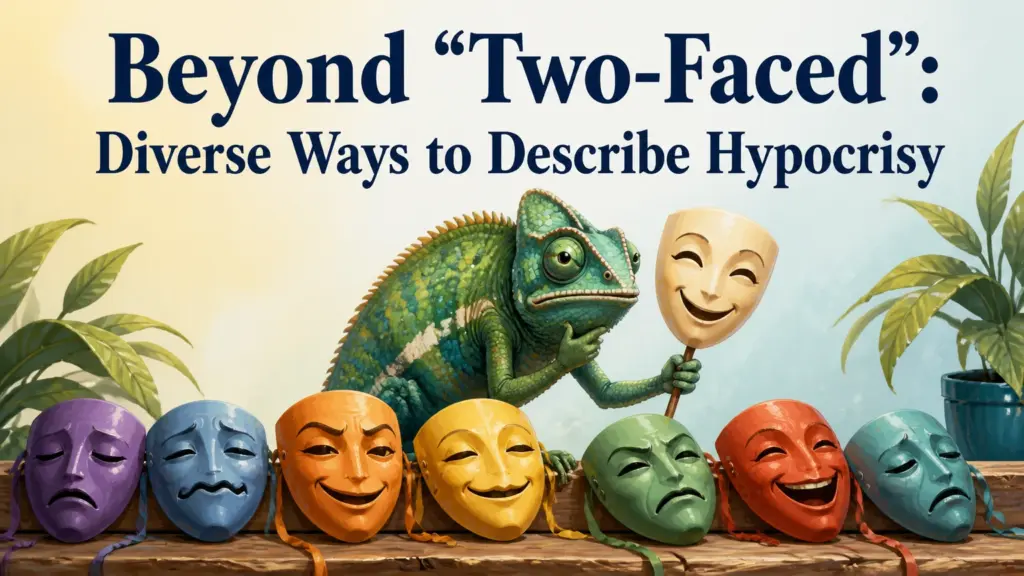

The term “two-faced” describes someone who says one thing to a person’s face and another behind their back. While easily understood, English offers a rich vocabulary to express this complex behavior with greater nuance. Synonyms like deceitful, insincere, duplicitous, and Janus-faced each carry slightly different connotations, highlighting specific aspects of hypocrisy. Understanding these varied expressions, including colloquial terms like “backstabber” or more formal words such as “perfidy,” allows for more precise and impactful communication. This article explores various ways to describe “two-faced” behavior, providing definitions, examples, and usage guidelines to enhance your understanding and application of these terms.
Table of Contents
- Definition of “Two-Faced” and Hypocrisy
- Structural Breakdown of Related Terms
- Types and Categories of Hypocritical Behavior
- Examples of Synonyms for “Two-Faced”
- Usage Rules and Nuances
- Common Mistakes
- Practice Exercises
- Advanced Topics: Exploring Related Concepts
- Frequently Asked Questions
- Conclusion
Definition of “Two-Faced” and Hypocrisy
At its core, “two-faced” describes someone who presents a false or contradictory appearance to different people. This behavior stems from hypocrisy, which involves claiming to have moral beliefs or virtues that one’s own actions contradict. A two-faced person might offer compliments to someone’s face while simultaneously spreading rumors about them behind their back. The essence of being two-faced lies in the discrepancy between outward appearance and true intentions.
The term implies a deliberate attempt to deceive and manipulate others for personal gain or advantage. It suggests a lack of integrity and trustworthiness, as the individual’s words and actions cannot be relied upon. Understanding the underlying motivation behind two-faced behavior is crucial for identifying and addressing it effectively.
Structural Breakdown of Related Terms
Analyzing the structure of words related to “two-faced” reveals their nuances. Many of these words are adjectives formed from nouns or verbs, often with prefixes or suffixes that modify their meaning. For example, “deceitful” is formed from the noun “deceit” with the suffix “-ful,” indicating a tendency or quality. “Insincere” uses the prefix “in-” to negate the meaning of “sincere,” highlighting a lack of genuineness. Breaking down these words helps to understand their precise connotations and usage.
Furthermore, understanding the etymology of these terms can provide additional insight. “Duplicitous” comes from the Latin word “duplex,” meaning “double” or “twofold,” emphasizing the duality of the person’s behavior. Recognizing these structural and etymological components enhances vocabulary and improves comprehension.
Types and Categories of Hypocritical Behavior
Hypocritical behavior manifests in various forms, each with its own characteristics. One common type is situational hypocrisy, where someone adheres to moral principles in certain contexts but abandons them in others. Another is moral grandstanding, where individuals publicly express strong moral views primarily to enhance their own reputation rather than out of genuine conviction. Professional hypocrisy occurs when someone violates the ethical standards of their profession while publicly upholding them. Understanding these categories helps to identify and analyze different instances of two-faced behavior.
Additionally, political hypocrisy is prevalent in the public sphere, where politicians may make promises they have no intention of keeping or criticize opponents for actions they themselves engage in. Religious hypocrisy involves individuals who profess strong religious beliefs but fail to live up to the standards of their faith. Recognizing these diverse forms of hypocrisy is essential for critical thinking and ethical decision-making.
Examples of Synonyms for “Two-Faced”
Numerous words and phrases can be used to describe someone who is two-faced, each with its own subtle shade of meaning. Here are some of the most common and useful alternatives:
Deceitful
Deceitful implies a deliberate attempt to mislead or deceive others. It focuses on the act of concealing the truth or presenting false information. A deceitful person might lie, cheat, or manipulate others to achieve their goals.
The following table provides examples of how “deceitful” can be used in sentences to describe someone who is two-faced:
| Sentence |
|---|
| Her deceitful smile hid her true intentions. |
| He made deceitful promises that he never intended to keep. |
| The company was accused of using deceitful marketing tactics. |
| The witness provided a deceitful testimony to protect the criminal. |
| She discovered his deceitful nature after finding hidden messages. |
| The politician’s deceitful behavior eroded public trust. |
| He was known for his deceitful schemes to gain wealth. |
| The con artist used deceitful methods to swindle people out of their money. |
| Her deceitful words masked her true feelings of resentment. |
| The investigation revealed a pattern of deceitful practices within the organization. |
| He built his career on deceitful tactics, betraying many along the way. |
| The deceitful advertisement promised results that were impossible to achieve. |
| She was shocked to learn about his deceitful past, which he had carefully hidden. |
| The spy engaged in deceitful activities to gather intelligence. |
| His deceitful charm made it easy for him to manipulate others. |
| The company faced legal action due to its deceitful financial reporting. |
| She uncovered a web of deceitful lies that shattered her trust in him. |
| The conman’s deceitful eyes never revealed his true intentions. |
| He was a master of deceitful manipulation, always getting what he wanted. |
| The deceitful plot involved betraying close friends for personal gain. |
| The deceitful smile vanished the moment she turned her back. |
| He used deceitful tactics to sabotage his rival’s project. |
| The deceitful contract contained hidden clauses that favored the company. |
| She was sick of his deceitful games and decided to end the relationship. |
| The deceitful politician promised change but delivered only empty words. |
| He crafted a deceitful alibi to cover up his involvement in the crime. |
| The deceitful leader used propaganda to control the population. |
| She realized that his compliments were nothing but deceitful flattery. |
| The deceitful facade crumbled under the weight of his lies. |
Insincere
Insincere suggests a lack of genuine feeling or emotion. It implies that someone is expressing sentiments that they do not truly feel. An insincere person might offer flattery or praise without meaning it.
The following table provides examples of how “insincere” can be used in sentences to describe someone who is two-faced:
| Sentence |
|---|
| Her insincere apology didn’t convince anyone. |
| He gave an insincere compliment that sounded forced and unnatural. |
| The politician’s insincere promises were met with skepticism. |
| She offered an insincere smile while secretly plotting against him. |
| His insincere concern for her well-being was clearly fake. |
| The company issued an insincere statement after the scandal broke. |
| He was tired of her insincere flattery and empty words. |
| The insincere gesture felt more like an obligation than a genuine expression of sympathy. |
| She couldn’t stand his insincere attempts to win her over. |
| The insincere praise seemed designed to manipulate him. |
| He offered an insincere greeting, barely making eye contact. |
| The insincere enthusiasm in her voice sounded rehearsed. |
| She saw through his insincere attempts to gain her trust. |
| His insincere compliments were a clear sign of his manipulative intentions. |
| The insincere apology lacked any real remorse. |
| She was disgusted by his insincere display of grief at the funeral. |
| His insincere praise felt like a veiled insult. |
| The insincere smile never reached her eyes. |
| He was known for his insincere charm, which he used to take advantage of people. |
| The insincere congratulations felt hollow and meaningless. |
| Her insincere concern was just a way to gather information. |
| He delivered an insincere speech filled with empty promises. |
| The insincere applause sounded forced and unenthusiastic. |
| She recognized the insincere look in his eyes immediately. |
| His insincere gestures of friendship were motivated by self-interest. |
| The insincere praise made her uncomfortable and suspicious. |
| He was adept at delivering insincere compliments that people wanted to hear. |
| The insincere apology was clearly just a formality. |
| She detected the insincere note in his voice as he offered his condolences. |
Duplicitous
Duplicitous emphasizes the act of deception and betrayal. It suggests that someone is deliberately misleading others through their words and actions. A duplicitous person might present one face to the world while secretly plotting against others.
The following table provides examples of how “duplicitous” can be used in sentences to describe someone who is two-faced:
| Sentence |
|---|
| His duplicitous behavior was eventually exposed. |
| She uncovered his duplicitous scheme to steal the company’s secrets. |
| The politician was accused of engaging in duplicitous practices. |
| He led a duplicitous life, hiding his true identity from everyone. |
| The company’s duplicitous tactics were designed to deceive investors. |
| She discovered his duplicitous nature after years of being deceived. |
| His duplicitous actions betrayed the trust of his friends and family. |
| The duplicitous plot involved manipulating several key players. |
| He was known for his duplicitous dealings in the business world. |
| The duplicitous agent worked for both sides, betraying each in turn. |
| She was shocked by the duplicitous lies he had told her. |
| His duplicitous charm masked his true intentions. |
| The duplicitous employee was fired for stealing company funds. |
| She uncovered a network of duplicitous individuals involved in the scam. |
| His duplicitous behavior made it impossible to trust him. |
| The duplicitous politician promised one thing but did another. |
| She was a victim of his duplicitous manipulation for years. |
| His duplicitous nature was eventually revealed to everyone. |
| The duplicitous scheme involved betraying the trust of close colleagues. |
| He was caught in his own web of duplicitous lies. |
| The duplicitous plot was so complex that it took months to unravel. |
| She couldn’t believe she had been fooled by his duplicitous charm. |
| His duplicitous actions had far-reaching consequences for everyone involved. |
| The duplicitous employee had been stealing from the company for years. |
| She was determined to expose his duplicitous nature to the world. |
| His duplicitous behavior was motivated by greed and ambition. |
| The duplicitous politician was eventually voted out of office. |
| She discovered the extent of his duplicitous actions through a series of leaked emails. |
| His duplicitous charm made him a dangerous adversary. |
Backstabber
Backstabber is a more informal and direct term for someone who betrays the trust of others, often in a sneaky or underhanded way. It implies that someone is attacking you from behind, without warning.
The following table provides examples of how “backstabber” can be used in sentences to describe someone who is two-faced:
| Sentence |
|---|
| He turned out to be a backstabber, spreading rumors about me behind my back. |
| She was betrayed by a backstabber who stole her ideas and presented them as their own. |
| I wouldn’t trust him; he’s known to be a backstabber. |
| The backstabber undermined her efforts at every turn. |
| He couldn’t believe his friend had become a backstabber, plotting against him. |
| She warned me about working with him, saying he’s a notorious backstabber. |
| The backstabber smiled to her face while secretly sabotaging her project. |
| He realized he was surrounded by backstabbers who were only interested in their own advancement. |
| She vowed to get revenge on the backstabber who had ruined her career. |
| The backstabber’s betrayal cut deep, leaving her feeling hurt and vulnerable. |
| He was wary of making new friends, fearing that they might turn out to be backstabbers. |
| She confronted the backstabber about their deceitful actions. |
| The backstabber’s lies were eventually exposed, and they faced the consequences. |
| He learned the hard way that some people are backstabbers in disguise. |
| She refused to let the backstabber’s actions define her. |
| The backstabber’s betrayal had a lasting impact on their relationship. |
| He was determined to rise above the backstabber’s attempts to bring him down. |
| She made it a point to avoid backstabbers in the workplace. |
| The backstabber’s actions spoke louder than their words. |
| He realized that the backstabber had been plotting against him all along. |
| She was shocked to discover that her closest confidante was a backstabber. |
| The backstabber’s actions had created a toxic environment in the office. |
| He vowed to never trust a backstabber again. |
| She learned to recognize the signs of a backstabber before it was too late. |
| The backstabber’s lies had caused irreparable damage to their friendship. |
| He was determined to expose the backstabber’s true nature to everyone. |
| She refused to let the backstabber win. |
| The backstabber’s actions had taught her a valuable lesson about trust. |
| He realized that the backstabber was motivated by jealousy and insecurity. |
Janus-Faced
Janus-faced, derived from the Roman god Janus who had two faces looking in opposite directions, describes someone who presents different appearances or opinions depending on the situation. It emphasizes the contradictory nature of their behavior.
The following table provides examples of how “Janus-faced” can be used in sentences to describe someone who is two-faced:
| Sentence |
|---|
| The politician’s Janus-faced approach allowed him to appeal to different groups. |
| She accused him of being Janus-faced, saying one thing to her and another to her boss. |
| His Janus-faced personality made it difficult to know his true intentions. |
| The company’s Janus-faced marketing campaign targeted two distinct demographics. |
| He adopted a Janus-faced strategy, presenting different arguments to different audiences. |
| Her Janus-faced behavior confused everyone around her. |
| The Janus-faced leader presented a different image to the public than he did in private. |
| He was known for his Janus-faced dealings in the business world. |
| She couldn’t trust him because of his Janus-faced nature. |
| The Janus-faced policy had unintended consequences for both groups it was intended to help. |
| He was adept at playing the Janus-faced game of politics. |
| She saw through his Janus-faced facade. |
| The Janus-faced approach was ultimately unsustainable. |
| He was criticized for his Janus-faced stance on the issue. |
| She refused to engage in Janus-faced behavior. |
| The Janus-faced company was eventually exposed for its hypocrisy. |
| He was tired of the Janus-faced nature of the industry. |
| She vowed to be honest and transparent, rejecting Janus-faced tactics. |
| The Janus-faced politician lost the trust of the public. |
| He found it exhausting to maintain a Janus-faced persona. |
| She realized that his Janus-faced behavior was a sign of deep insecurity. |
| The Janus-faced policy created more problems than it solved. |
| He was forced to choose between his Janus-faced roles. |
| She refused to compromise her values by adopting a Janus-faced approach. |
| The Janus-faced leader was eventually overthrown. |
| He learned that honesty was the best policy, even if it meant abandoning his Janus-faced strategy. |
| She realized that his Janus-faced behavior was hurting those around him. |
| The Janus-faced company was boycotted by consumers. |
Treacherous
Treacherous describes someone who is likely to betray or deceive, often in a dangerous or harmful way. It emphasizes the potential for harm and the violation of trust.
The following table provides examples of how “treacherous” can be used in sentences to describe someone who is two-faced:
| Sentence |
|---|
| He was a treacherous friend who betrayed her secrets to their rivals. |
| The treacherous path to success involved stepping on others to get ahead. |
| She discovered his treacherous plot to overthrow the government. |
| The treacherous employee was leaking confidential information to the competition. |
| He was warned about the treacherous nature of the business world. |
| She realized she had been betrayed by a treacherous ally. |
| The treacherous deal left her financially ruined. |
| He vowed to seek revenge on the treacherous individual who had wronged him. |
| She was shocked by the treacherous depths of his deception. |
| The treacherous terrain made the journey dangerous and difficult. |
| He navigated the treacherous political landscape with caution. |
| She was wary of his treacherous charm. |
| The treacherous scheme was designed to enrich a few at the expense of many. |
| He was caught in a treacherous web of lies. |
| She learned the hard way that some people are treacherous and cannot be trusted. |
| The treacherous act had devastating consequences for everyone involved. |
| He was determined to expose the treacherous individuals who were corrupting the system. |
| She refused to compromise her values, even in the face of treacherous temptations. |
| The treacherous leader led his followers astray. |
| He realized that he had underestimated the treacherous nature of his opponent. |
| She was betrayed by a treacherous lover. |
| The treacherous path to power was paved with broken promises and betrayal. |
| He was forced to make a treacherous decision that would affect the lives of many. |
| She refused to be a party to his treacherous schemes. |
| The treacherous employee was eventually brought to justice. |
| He learned that trust is a precious commodity that can be easily destroyed by treacherous actions. |
| She was determined to protect herself from his treacherous advances. |
| The treacherous deal was too good to be true. |
Usage Rules and Nuances
While the words discussed above are often interchangeable with “two-faced,” it’s important to understand their specific connotations to use them accurately. “Deceitful” and “duplicitous” emphasize the act of deception itself, while “insincere” highlights the lack of genuine feeling. “Backstabber” is a more informal term that focuses on the betrayal of trust. “Janus-faced” underscores the contradictory nature of the person’s behavior, and “treacherous” implies a dangerous or harmful level of betrayal.
Consider the context when choosing the most appropriate term. If you want to emphasize the deliberate nature of the deception, “deceitful” or “duplicitous” might be the best choice. If you want to highlight the lack of genuine emotion, “insincere” is more suitable. For a direct and informal description of betrayal, “backstabber” is appropriate. When emphasizing contradictory behavior, “Janus-faced” is a good option. If the betrayal is particularly dangerous or harmful, “treacherous” is the best fit.
Common Mistakes
One common mistake is using “insincere” when “deceitful” is more appropriate. “Insincere” refers to a lack of genuine feeling, while “deceitful” implies a deliberate attempt to mislead. For example, saying “He gave an insincere alibi” is incorrect; it should be “He gave a deceitful alibi.” Another mistake is using “backstabber” in formal contexts. “Backstabber” is an informal term and should be avoided in professional or academic writing.
Another frequent error is interchanging “duplicitous” and “Janus-faced” without considering their specific nuances. While both describe a kind of double-dealing, “duplicitous” focuses on the intent to deceive and betray, while “Janus-faced” highlights the presentation of different appearances to different groups, without necessarily implying active betrayal. To avoid these mistakes, always consider the specific meaning and context of each word.
Here are some examples of common mistakes and their corrections:
| Incorrect | Correct |
|---|---|
| He was very insincere to steal the money. | He was very deceitful to steal the money. |
| The CEO is a backstabber, according to the annual report. | The CEO engaged in duplicitous behavior, according to the annual report. |
| Her Janus-faced actions were simply dishonest. | Her duplicitous actions were simply dishonest. |
| The treacherous compliment made her suspicious. | The insincere compliment made her suspicious. |
Practice Exercises
Test your understanding of the different ways to describe “two-faced” behavior with these exercises. Choose the most appropriate word from the list below to complete each sentence.
Word List: deceitful, insincere, duplicitous, backstabber, Janus-faced, treacherous
| Question | Answer |
|---|---|
| 1. His __________ smile didn’t fool anyone; everyone knew he was lying. | insincere |
| 2. She was a __________ friend, always pretending to be supportive while secretly undermining her efforts. | backstabber |
| 3. The __________ politician promised one thing to his constituents and another to his corporate sponsors. | Janus-faced |
| 4. The company engaged in __________ practices, misleading customers about the safety of their products. | deceitful |
| 5. He led a __________ life, hiding his true identity and intentions from those around him. | duplicitous |
| 6. The __________ journey to power involved betraying allies and making ruthless decisions. | treacherous |
| 7. Her __________ apology sounded forced and lacked any genuine remorse. | insincere |
| 8. He discovered that his business partner was a __________, stealing company secrets and selling them to competitors. | backstabber |
| 9. The __________ leader made promises to both sides of the conflict, but ultimately served only his own interests. | Janus-faced |
| 10. The __________ advertisement promised impossible results, preying on people’s hopes and fears. | deceitful |
| 11. She uncovered a __________ plot to overthrow the government and install a new regime. | duplicitous |
| 12. He found himself in a __________ situation, where any wrong move could lead to disaster. | treacherous |
| 13. His __________ compliments were clearly designed to manipulate her into doing what he wanted. | insincere |
| 14. She realized that her so-called friend was a __________ who had been spreading rumors about her behind her back. | backstabber |
| 15. The __________ negotiator presented different positions to each side, hoping to secure a favorable deal for himself. | Janus-faced |
| 16. The __________ salesman used high-pressure tactics to trick customers into buying overpriced products. | deceitful |
| 17. He was leading a __________ double life, maintaining a facade of respectability while secretly engaging in criminal activities. | duplicitous |
| 18. The __________ climb to the top was fraught with danger and required him to make difficult choices. | treacherous |
| 19. The __________ concern he showed at the meeting didn’t fool anyone, as everyone knew he was just trying to score political points. | insincere |
| 20. Despite her friendly demeanor, she was known as a __________, always ready to stab someone in the back to get ahead. | backstabber |
Advanced Topics: Exploring Related Concepts
Beyond the direct synonyms discussed above, several related concepts can further enrich your understanding of “two-faced” behavior. Machiavellianism, for example, describes a personality trait characterized by manipulativeness, cynicism, and a disregard for morality. People with high Machiavellian traits are often skilled at exploiting others and achieving their goals through deception.
Another related concept is cognitive dissonance, which refers to the mental discomfort experienced when holding conflicting beliefs or values. To reduce this discomfort, individuals may rationalize their behavior or change their beliefs to align with their actions, sometimes leading to hypocritical behavior. Exploring these advanced topics provides a deeper understanding of the psychological and social factors that contribute to two-faced behavior.
Frequently Asked Questions
- What is the difference between “two-faced” and “hypocritical”?
“Two-faced” specifically describes someone who presents different appearances to different people, while “hypocritical” refers to someone who claims to have moral beliefs that their actions contradict. While related, “two-faced” focuses on the outward deception, and “hypocritical” emphasizes the discrepancy between beliefs and actions. A two-faced person is usually hypocritical, but a hypocritical person isn’t always two-faced.
- Is “backstabber” an appropriate term to use in formal writing?
No, “backstabber” is an informal term and should be avoided in formal writing. More appropriate alternatives include “deceitful,” “duplicitous,” or “treacherous,” depending on the specific context.
- How can I identify someone who is two-faced?
Look for inconsistencies between their words and actions, a tendency to gossip or spread rumors, and a pattern of offering insincere compliments or praise. Trust your instincts and be wary of individuals who seem too good to be true.
- What should I do if I suspect someone is being two-faced towards me?
Document any instances of inconsistent or suspicious behavior. Confront the person directly, but be prepared for denial or gaslighting. If the behavior continues or escalates, consider limiting your contact with the person or seeking advice from a trusted friend or colleague.
- Can someone be unintentionally two-faced?
While it’s possible for someone to unintentionally present conflicting messages or appearances, the core of being “two-faced” generally implies a deliberate intent to deceive or manipulate. Unintentional inconsistencies might be due to a lack of self-awareness or poor communication skills, rather than malicious intent.
- How does cultural context affect the perception of “two-faced” behavior?
Cultural norms can influence what is considered “two-faced.” In some cultures, indirect communication or saving face may be valued, which could be perceived as insincere or duplicitous by someone from a more direct culture. Understanding these cultural differences is crucial for avoiding misunderstandings and misinterpretations.
- What are the psychological motivations behind “two-faced” behavior?
Several psychological factors can contribute to “two-faced” behavior, including a desire for power, a need for approval, insecurity, and a lack of empathy. Some individuals may engage in deception and manipulation to achieve their goals, while others may do so to protect themselves from perceived threats or to maintain a positive self-image.
- Is there a positive side to being “Janus-faced”?
While generally negative, being “Janus-faced” can sometimes be useful in certain situations, such as diplomacy or negotiation. The ability to see multiple perspectives and adapt one’s approach accordingly can be beneficial in resolving conflicts and reaching agreements. However, it’s important to maintain ethical boundaries and avoid engaging in outright deception or manipulation.
Conclusion
Mastering the nuances of language allows for more effective and precise
communication. By understanding the subtle differences between synonyms for “two-faced,” you can better articulate your thoughts and observations. Whether you choose “deceitful,” “insincere,” “duplicitous,” “backstabber,” “Janus-faced,” or “treacherous,” the key is to select the word that best captures the specific nature of the behavior you are describing. This enhanced vocabulary will empower you to navigate complex social situations with greater clarity and confidence.